
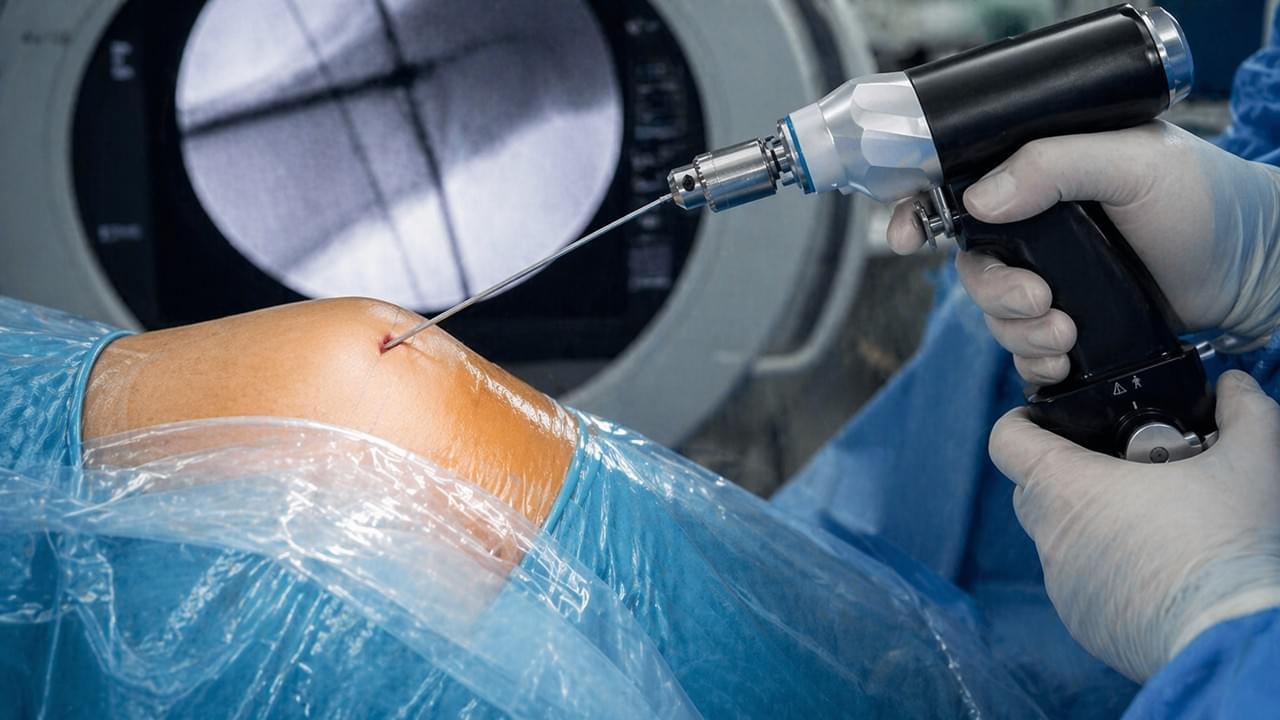
This article is part of our comprehensive guide: Orthopedic Power Tools: The Complete Guide to Surgical Drills, Saws & Systems
TL;DR: A cannulated drill is a bone drill with a hollow center that slides over a pre-placed guide wire, enabling precise, minimally invasive bone drilling without wide surgical exposure. This article covers the technical design of cannulated drills, the step-by-step MIS drilling technique, clinical advantages in fracture fixation and ligament reconstruction, and key selection criteria for surgical teams and procurement officers.
What Is a Cannulated Drill?
Definition: A cannulated drill (also called a hollow drill or guide-wire drill) is a surgical bone drill featuring a central longitudinal bore that allows the drill to pass coaxially over a K-wire or guide pin already placed in the target bone. This design is fundamental to minimally invasive surgery (MIS) in orthopedics.
The term “cannulated” derives from the Latin cannula (small tube) — reflecting the hollow, tube-like geometry of the drill’s cross-section. Cannulated drills are manufactured in standard orthopedic sizes (typically 2.0 mm to 12.0 mm outer diameter), with central bore diameters matched to standard guide wire sizes (1.2 mm, 1.6 mm, 2.0 mm, 2.4 mm, and larger).
🔧How Cannulated Drilling Works: The MIS Technique
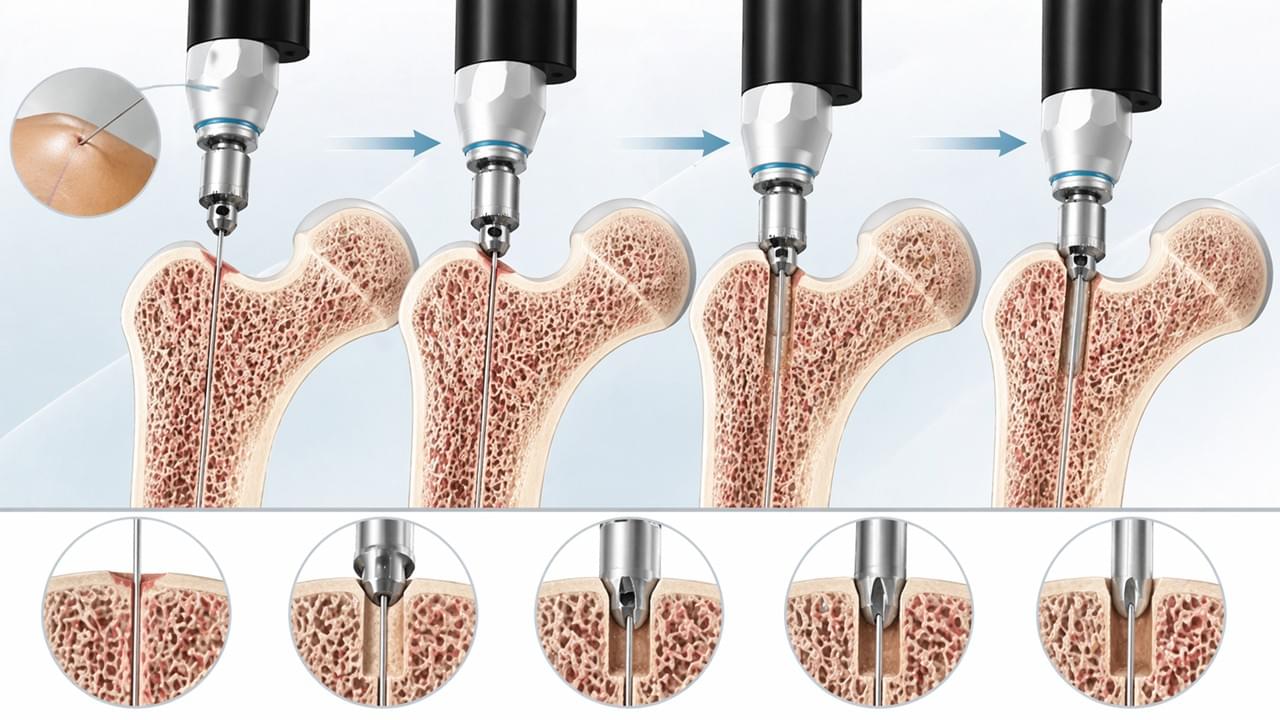
Step 1: Guide Wire Placement
Under fluoroscopic (X-ray) guidance, the surgeon inserts a guide wire (K-wire or threaded guide pin) percutaneously through a small stab incision and advances it to the precise target position within the bone. Fluoroscopy confirms correct positioning in two planes.
This step is the critical precision step: the guide wire defines the final trajectory of the screw or implant.
Step 2: Cannulated Drill Insertion
The cannulated drill is threaded over the guide wire and advanced to the bone surface through the same small incision. The drill follows the exact trajectory established by the guide wire — ensuring the resulting drill hole is precisely located without opening the fracture site.
Step 3: Drilling Under Power
The drill is advanced through the bone at controlled speed (typically 400–1,200 RPM for cortical bone) with intermittent irrigation to manage heat generation. The guide wire remains in place throughout drilling, maintaining trajectory.
Step 4: Guide Wire Retention, Screw Placement
After drilling, the guide wire remains in position while the cannulated drill is removed. A cannulated screw is then threaded over the same guide wire and driven into the drill hole — completing the fixation cycle.
💡 Clinical Advantages of Cannulated Drilling in MIS
| Advantage | Clinical Impact |
| Minimal incision | 5–8 mm stab incision vs. 5–8 cm open approach |
| Preserved soft tissue | Muscle and periosteum not stripped; blood supply maintained |
| Precision trajectory | Guide wire anchors drill path; zero trajectory drift |
| Reduced blood loss | Minimal soft tissue disruption reduces intraoperative blood loss |
| Faster recovery | Less tissue trauma = less pain, faster rehabilitation |
| Lower infection risk | Smaller wound surface reduces contamination exposure |
| Fluoroscopic verification | Each step confirming under X-ray before committing |
🏥Clinical Applications of Cannulated Drills
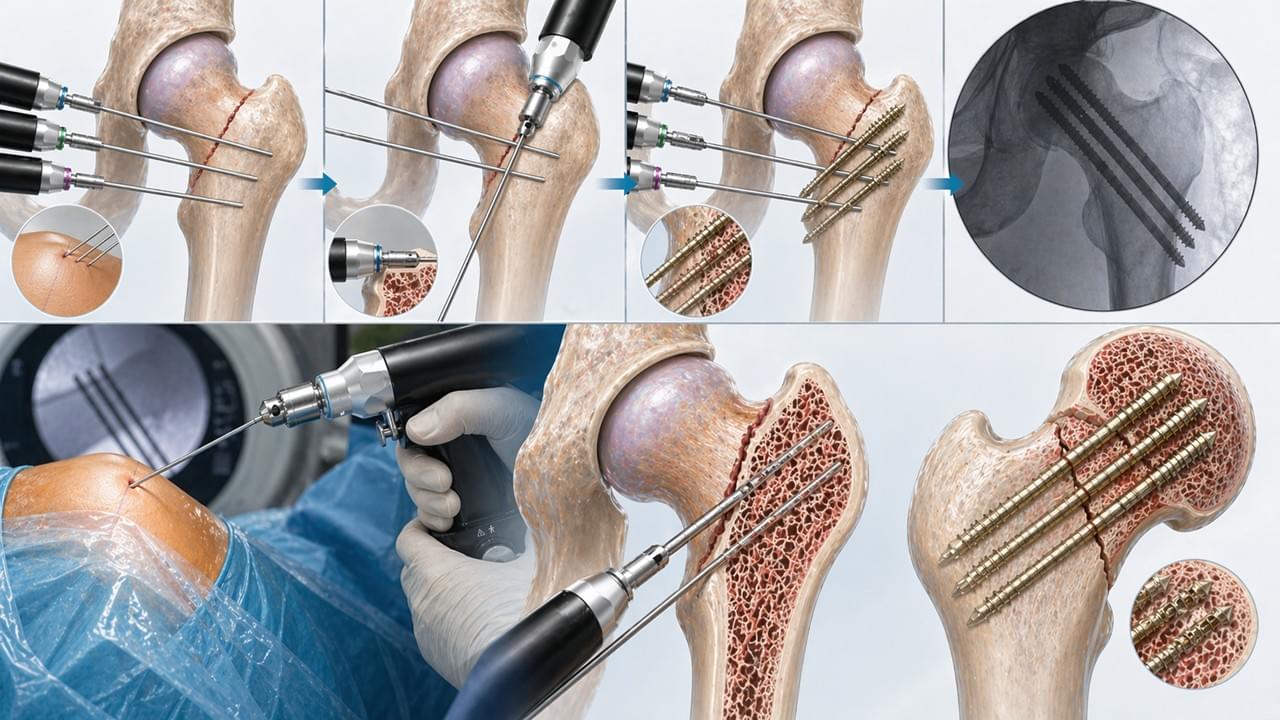
Hip Fracture Fixation (Femoral Neck and Intertrochanteric Fractures)
Cannulated screws placed over guide wires are the standard treatment for femoral neck fractures, particularly in younger patients where fracture reduction and fixation are preferred over arthroplasty. Three parallel cannulated screws provide stable fixation of the femoral head while preserving the femoral head blood supply.
Anterior Cruciate Ligament (ACL) Reconstruction
Arthroscopic ACL reconstruction uses cannulated drilling systems to create bone tunnels in the tibia and femur for graft passage. Precision tunnel placement (anatomic footprint accuracy) is critical to graft function and is enabled by guide wire-directed cannulated drilling.
Scaphoid Fracture Fixation
Percutaneous fixation of scaphoid wrist fractures with a single cannulated headless compression screw (Herbert screw) has become the gold standard for active patients. The small central carpal bone demands extreme precision in screw trajectory — achievable only with cannulated drilling technique.
Pediatric Fracture Fixation (ESIN/Flexible Nails)
Elastic stable intramedullary nailing (ESIN) in children uses cannulated drill systems to create precise cortical entry points for flexible titanium nails in femur and tibia fractures — minimizing physeal and cortical trauma.
⚙️ Key Technical Parameters: Selecting a Cannulated Drill System
When specifying cannulated drills for an orthopedic department or surgical kit, evaluate:
| Parameter | Specification Notes |
| Outer diameter range | Match to screw system (e.g., 4.0 mm cannulated screw requires compatible drill) |
| Central bore diameter | Must match guide wire diameter with minimal clearance |
| Flute geometry | Sharp flutes, appropriate helix angle for bone material |
| Length | Available in standard and extra-long for deep drilling |
| Material | Surgical-grade stainless steel or titanium; autoclave-compatible |
| Connection | Quick-release or AO connection to compatible power drill |
| Drill system compatibility | Verify compatibility with existing power drill platform |
👉 Explore full systems here:
🔗 Orthopedic Power Tools Product Page
⚠️Expert Advisory: Avoiding Common Cannulated Drilling Errors
Vsun Medical Surgical Engineering Team:
- Guide wire bending:A bent guide wire causes drill trajectory deviation. Always inspect the guide wire before use; replace if any curvature is visible.
- Thermal damage:Intermittent drilling with frequent withdrawal for debris clearance prevents heat buildup in the drill channel. Continuous irrigation reduces thermal bone necrosis risk.
- Guide wire advancement during drilling:The drill rotation can advance the guide wire deeper into bone. Use a guide wire holder or confirm wire position under fluoroscopy after drilling.
- Drill bit dulling:Cannulated drill bits dull faster than solid bits due to reduced cross-sectional cutting area. Single-use bits eliminate this risk; reusable bits require sharpness verification.
📚 Best practices are also supported by:
FAQ
Q1: What is the difference between a cannulated drill and a standard bone drill?
A cannulated drill has a hollow center bore that allows it to slide coaxially over a pre-placed guide wire, enabling guide wire-directed drilling in minimally invasive surgery. A standard solid bone drill has no central bore and must be positioned by direct visualization or anatomic landmarks without guide wire guidance.
Q2: What guide wire sizes are compatible with cannulated drills?
Standard cannulated drill systems are designed around guide wire diameters of 1.2 mm, 1.6 mm, 2.0 mm, and 2.4 mm. The drill’s central bore is marginally larger than the guide wire to allow free passage without excessive play. Always verify drill/guide wire system compatibility before clinical use.
Q3: Can cannulated drills be reused after autoclave sterilization?
Yes, high-quality surgical-grade stainless steel cannulated drills from GMP-certified manufacturers like Vsun Medical are validated for multiple autoclave sterilization cycles. However, drill bit cutting edge sharpness must be verified before each use; replace when cutting efficiency is reduced. Single-use cannulated drills are also available for systems requiring guaranteed edge sharpness.
Q4: What RPM is recommended for cannulated bone drilling?
For cortical bone drilling with cannulated bits, 400–1,200 RPM is the recommended range, with intermittent withdrawal for debris clearance and cooling. Higher speeds generate more heat; lower speeds risk walking. Follow the specific system manufacturer’s recommendations for the drill diameter and bone type.
Upgrade Your Minimally Invasive Surgery Instrument Set
Vsun Medical’s cannulated drill systems — designed for guide wire-directed precision in MIS orthopedic procedures — are manufactured under GMP standards with ISO certification and a 2-year warranty.
Explore our complete orthopedic power tool range for MIS applications.
👉Request Technical Specifications → vsunmedical.com/contact
GMP Compliant · ISO Certified · 2-Year Warranty
 English
 Arabic
 German
 French
 Italian
 Spanish
 Russian
 Japanese
 Korean
 Turkish
 Portuguese