
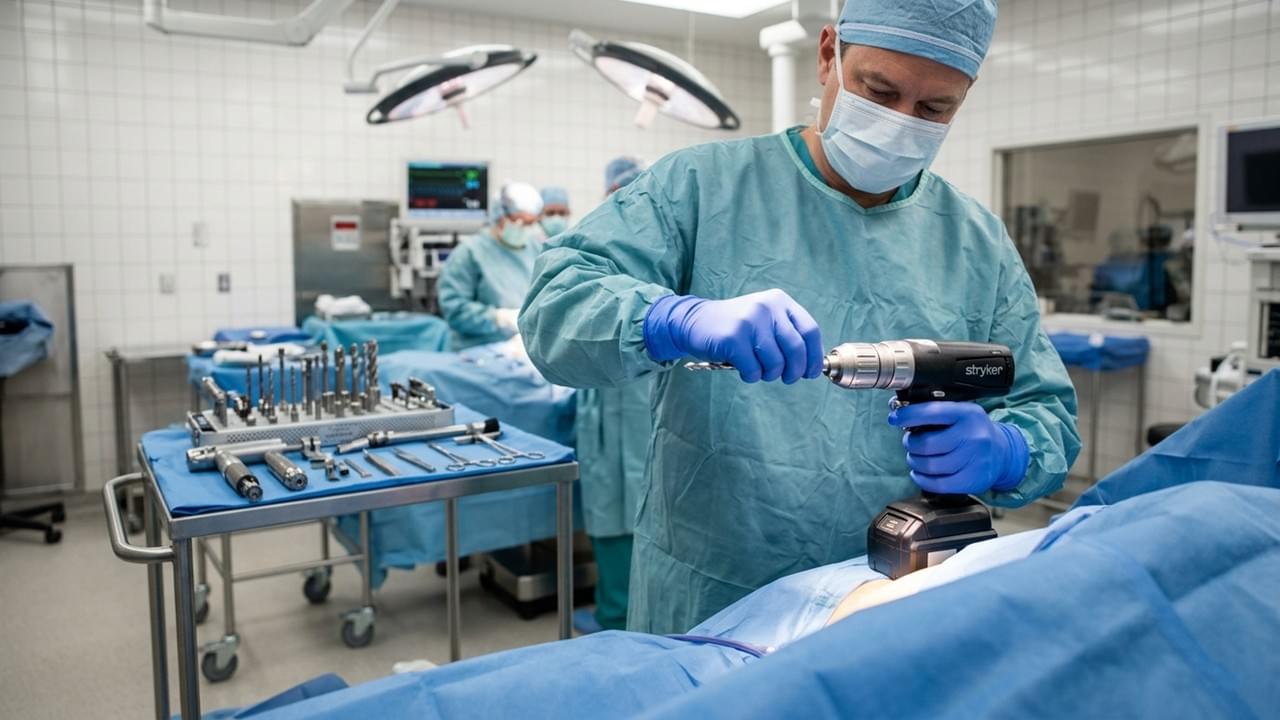
TL;DR: Orthopedic power tools — including bone drills, oscillating saws, and reaming systems — are essential instruments in modern surgical procedures. This comprehensive guide covers the classifications, core technical parameters (RPM, torque), clinical applications, procurement criteria, sterilization standards, and how to select the right orthopedic instrument manufacturer. Whether you are a hospital procurement officer, orthopedic surgeon, or medical equipment distributor, this guide delivers the critical knowledge you need to make informed decisions.
What Are Orthopedic Power Tools? A Clinical Definition
Orthopedic power tools are motorized surgical instruments designed specifically for bone-related procedures. They deliver precise, controlled mechanical force to perform tasks such as drilling, cutting, reaming, and shaping hard biological tissue — functions that cannot be achieved with manual instruments alone.
In modern orthopedic surgery, power tools are indispensable for procedures including fracture fixation, joint replacement (arthroplasty), spinal fusion, and bone tumor resection. The term “orthopedic power tools” encompasses a broad product family: electric or pneumatic drives, interchangeable attachments (drill bits, saw blades, burrs), sterile handles, and associated battery or compressed-air delivery systems.
Understanding these tools requires familiarity with three core dimensions: mechanical classification, power source type, and clinical application context — all covered in depth below.
Types of Orthopedic Power Tools: Drills, Saws, and Beyond
Bone Drills: Precision Penetration for Fixation and Biopsy
A surgical bone drill creates precise holes in cortical and cancellous bone for screw fixation, K-wire placement, intramedullary nail insertion, or bone biopsy. Key parameters include:
- Rotational speed (RPM): Typically 0–1,500 RPM for slow-speed precision drilling; up to 35,000 RPM for high-speed burrs
- Torque output: Measured in N·cm; higher torque enables penetration of dense cortical bone
- Chuck compatibility: Quick-release or Jacobs chuck systems for rapid blade exchange in the sterile field
Cannulated drills — a subcategory designed to pass over guide wires — are critical in minimally invasive surgery (MIS). They enable accurate screw placement without wide tissue dissection, reducing patient recovery time significantly.
Oscillating and Reciprocating Saws: Precision Cutting Platforms
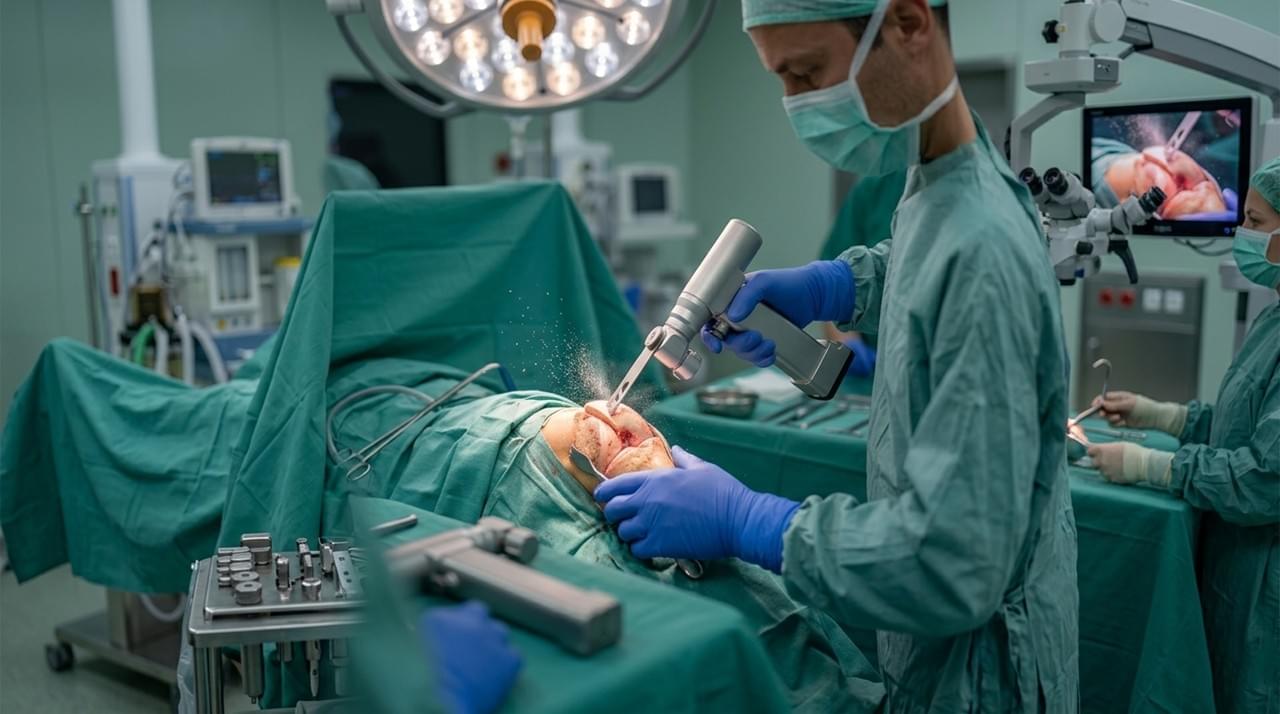
Surgical bone saws operate via oscillating (side-to-side) or reciprocating (back-and-forth) blade motion. They are used in:
- Total knee and hip arthroplasty (cutting femoral and tibial surfaces)
- Amputation and limb-salvage surgery
- Corrective osteotomy procedures
Blade material matters critically. High-carbon steel blades offer low cost but limited durability. Stainless steel and titanium nitride (TiN) coated blades deliver superior edge retention and corrosion resistance across multiple sterilization cycles. Blade geometry — tooth pitch, kerf width — directly affects cut accuracy and bone heat generation.
Bone Reamers and Burrs: Shaping the Canal
Reamers enlarge the medullary canal in long bones for intramedullary nailing. Burrs (rotary cutters) perform fine bone contouring in spinal surgery, joint preparation, and cavity debridement. Speed control is paramount: excessive speed generates heat that can induce bone necrosis, a serious complication.
Screwdrivers and Wire Drivers: Fixation Completion
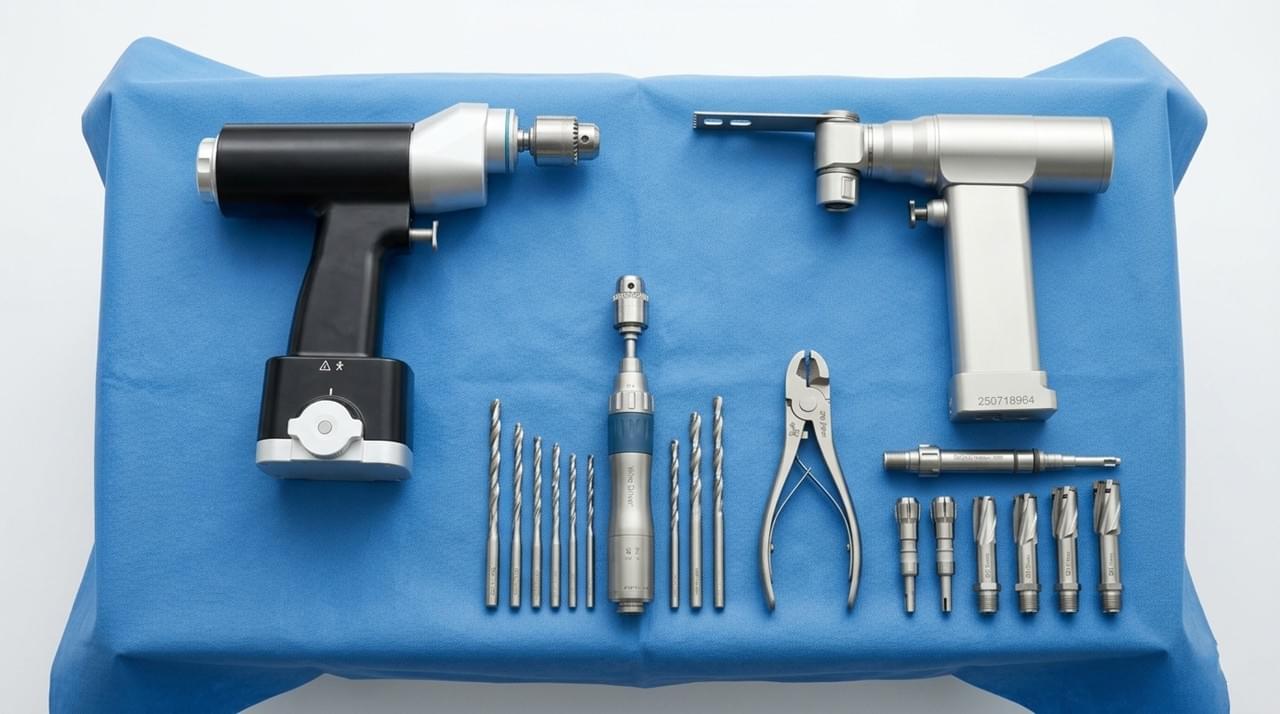
Battery-powered screwdriver attachments drive cortical, cancellous, and locking screws with controlled torque. Wire drivers insert K-wires and Steinmann pins for temporary or definitive fixation. These tools complete the fixation workflow begun by drills and saws.
Power Sources: Pneumatic vs. Electric Orthopedic Tools
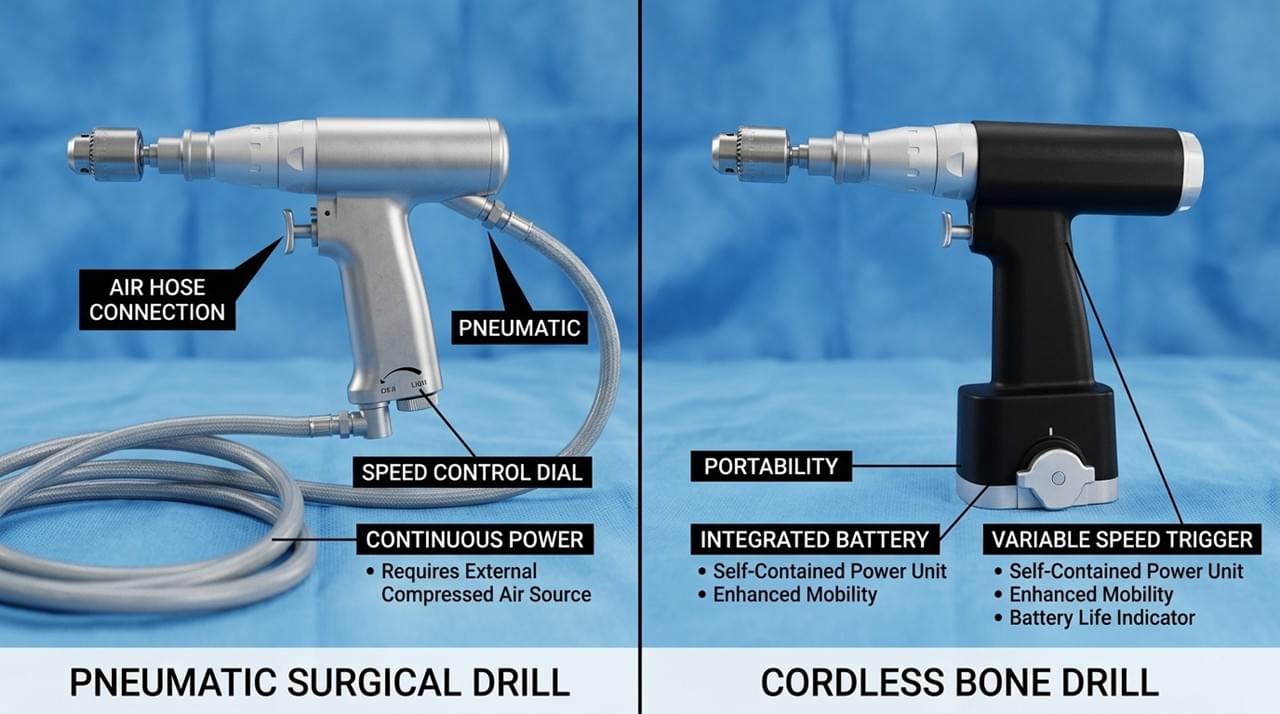
| Feature | Pneumatic (Air-Powered) | Electric (Battery/Corded) |
|---|---|---|
| Power Source | Hospital compressed air supply | Rechargeable Li-ion battery or AC power |
| Weight | Lighter handpiece | Slightly heavier (battery pack) |
| Speed Control | Excellent throttle response | Precise electronic speed regulation |
| Sterility | Hose connects to non-sterile air supply | Fully autoclavable cordless units available |
| Operating Cost | Low (air is cheap) | Higher (battery replacement cycles) |
| Portability | Limited by hose reach | High (battery models fully portable) |
| Preferred Setting | Large hospitals with central air | Smaller clinics, field surgery, veterinary use |
| Torque at Low Speed | Drops at low RPM | Maintained via electronic control |
Expert Perspective (Vsun Medical Technical Team): “For high-volume joint replacement centers, pneumatic tools remain the gold standard for power consistency. However, the shift toward battery-powered systems is accelerating, driven by demand for cordless sterile fields and compatibility with robotic-assisted surgery platforms. Vsun Medical engineers both to the same GMP manufacturing standard — the choice depends on your operating environment, not product quality.”
Core Technical Parameters: What Surgeons and Buyers Must Know
When evaluating orthopedic power tools for procurement, the following parameters must be reviewed in product specifications:
Speed (RPM)
- Low speed: 0–300 RPM — for tapping, screwing, K-wire insertion
- Medium speed: 300–3,000 RPM — for standard drilling and reaming
- High speed: 10,000–35,000 RPM — for burrs and fine bone shaping
Torque (N·cm)
Torque determines the ability to penetrate dense bone. Insufficient torque causes tool stall and generates excessive heat. Adequate torque preserves cutting efficiency with minimal thermal damage.
Vibration and Noise Levels
Sustained vibration causes surgeon fatigue and reduces precision. Premium orthopedic power tools use counterbalanced motor designs to minimize vibration transmission to the operator’s hand.
Sterilization Compatibility
All surgical-grade orthopedic power tools must withstand repeated autoclave sterilization (134°C steam, 18 min cycles). Look for IP ratings, sealed motor housings, and manufacturer-specified autoclave cycle limits per device.
Clinical Applications: Where Orthopedic Power Tools Are Used
Trauma Surgery
Fracture fixation requires drilling for plate screws, intramedullary nailing requiring reaming, and external fixator pin insertion. Speed, precision, and reliability under emergency conditions are paramount.
Joint Replacement (Arthroplasty)
Total hip and knee arthroplasty demand precise bone cuts aligned to anatomical landmarks. Oscillating saws with calibrated cutting guides ensure prosthetic component seating accuracy critical to long-term implant survival.
Spinal Surgery
High-speed burrs and rongeurs prepare vertebral endplates and create pedicle channels. The confined surgical corridor demands compact, lightweight tool designs with excellent torque-to-size ratios.
Pediatric Orthopedics
Smaller, lower-torque tools with finer pitch drill bits are required to protect growth plates and minimize osseous damage in pediatric patients.
Veterinary Orthopedic Surgery
A growing segment of the orthopedic power tool market serves veterinary clinics and hospitals. Vsun Medical produces a dedicated veterinary instrument line designed for small-animal anatomy, with compact handpieces and specialized attachment systems. See our full guide: Modernizing Veterinary Orthopedic Surgery
How to Select an Orthopedic Instrument Manufacturer: 7 Critical Criteria
Choosing the right orthopedic instrument manufacturer is a strategic decision affecting patient safety, operational efficiency, and long-term procurement cost. Evaluate suppliers against these seven criteria:
- GMP Compliance: Manufacturing must comply with Good Manufacturing Practice (GMP) standards. GMP certification ensures consistent production quality, validated processes, and traceable material sourcing.
- ISO Certification: Look for ISO 13485 (medical device quality management systems) and ISO 9001 (general quality management). These certifications demonstrate systematic quality control.
- Product Warranty: A minimum 2-year product warranty signals manufacturer confidence in durability. Vsun Medical provides a 2-year warranty on all orthopedic power tools as standard.
- Sterilization Validation: The manufacturer should provide documented autoclave cycle data per product, confirming material integrity after repeated sterilization.
- Clinical Portfolio Breadth: A specialist manufacturer offering the full spectrum — drills, saws, reamers, wire drivers, and attachments — enables streamlined procurement and system compatibility.
- Global Supply Chain Capability: For international buyers and distributors, assess the manufacturer’s ability to fulfill small MOQ orders, manage customs documentation, and provide logistics support (DHL, FedEx, freight forwarding).
- Technical Support: Remote and on-site technical support, training materials, and spare parts availability are essential for long-term partnership value.
Related Reading: Quality Standards in Medical Manufacturing — GMP, ISO, and Beyond
Maintenance and Sterilization: Extending Tool Service Life
Proper maintenance is not optional — it directly affects patient safety and total cost of ownership.
Pre-Sterilization Cleaning Protocol
- Disassemble attachments per manufacturer instructions
- Rinse with enzymatic detergent solution, 40°C
- Ultrasonic cleaning: 10–15 minutes
- Rinse with distilled water; air dry or use absorbent lint-free cloth
- Inspect for visible damage before sterilization
Sterilization Methods
- Steam Autoclave (preferred): 134°C, 18 min — suitable for most metal instruments
- Ethylene Oxide (EO): For heat-sensitive electronic components
- Hydrogen Peroxide Plasma: Emerging method for complex battery-powered systems
Lubrication and Storage
Tool handpieces require periodic lubrication with manufacturer-approved surgical-grade oil before sterilization. Store in sterile trays or pouches at controlled temperature (15–25°C) and relative humidity (<60%).
Related Reading: Orthopedic Power Tool Sterilization and Maintenance Manual
Comparison Table: Leading Orthopedic Power Tool System Types
| Tool Type | Primary Application | Speed Range | Key Selection Criterion | Typical Users |
|---|---|---|---|---|
| Cannulated Drill | MIS, fracture fixation | 0–2,000 RPM | Guide-wire compatibility | Trauma surgeons, MIS specialists |
| Oscillating Saw | Arthroplasty, osteotomy | 8,000–20,000 OPM | Blade system breadth | Joint replacement surgeons |
| High-Speed Burr | Spine, joint prep | 10,000–35,000 RPM | Heat dissipation | Spine surgeons, neurosurgeons |
| Wire Driver | K-wire, pin insertion | 0–800 RPM | Clutch torque control | Trauma, pediatric orthopedics |
| Reamer | Intramedullary nailing | 200–1,500 RPM | Canal clearance geometry | Trauma surgeons |
| Battery Screwdriver | Screw fixation | 0–400 RPM | Torque accuracy | General orthopedics |
Expert Advisory: Key Trends in Orthopedic Power Tools (2025–2030)
Vsun Medical R&D Insights:
The orthopedic power tool market is undergoing significant transformation driven by three macro trends:
- Miniaturization for MIS: Surgical corridors are narrowing as minimally invasive techniques advance. Demand for ultra-compact, high-torque handpieces is accelerating. Read more: Innovations in Minimally Invasive Surgery Power Tools
- Smart Tool Integration: Sensors embedded in drill handles provide real-time feedback on bone density, breakthrough detection, and torque limits, reducing the risk of cortical perforation.
- Single-Use Systems: Hospital infection control programs are increasingly adopting single-use drill and saw systems to eliminate sterilization complexity and cross-contamination risk.
FAQ — Frequently Asked Questions
Q1: What is the difference between an orthopedic drill and a standard power drill?
Orthopedic power drills are specifically engineered for bone surgery: they are autoclave-sterilizable, constructed from surgical-grade stainless steel, provide precise speed and torque control for bone hardness variation, and accept specialized surgical attachments (cannulated bits, K-wire chucks). Standard power drills lack sterilization compatibility and the precision required for safe clinical use.
Q2: How many sterilization cycles can surgical power tools withstand?
High-quality orthopedic power tools from GMP-compliant manufacturers are typically validated for 300–500 autoclave sterilization cycles (134°C, 18 min) before requiring servicing or replacement of wear components. Always consult the manufacturer’s specific documentation. Vsun Medical provides cycle ratings in product technical sheets.
Q3: What certifications should an orthopedic instrument manufacturer hold?
At minimum, look for ISO 13485 (medical device quality management), GMP compliance certification, and CE marking for European markets or FDA registration for US market access. Vsun Medical holds ISO certification and maintains GMP-compliant manufacturing processes across all product lines.
Q4: What is a cannulated drill and why is it important in minimally invasive surgery?
A cannulated drill has a hollow center that allows it to pass over a guide wire. In minimally invasive surgery (MIS), a surgeon first places a guide wire at the exact target position under fluoroscopic guidance, then uses the cannulated drill to create a precisely located hole without open dissection — dramatically reducing tissue trauma, blood loss, and recovery time.
Q5: How should I compare orthopedic power tool suppliers for bulk procurement?
Evaluate suppliers across: GMP/ISO certification status, product warranty terms (minimum 2 years), sterilization cycle validation data, MOQ flexibility, global logistics capability, and after-sales technical support responsiveness. Request product samples and technical datasheets before committing to volume orders.
Ready to Upgrade Your Surgical Power Tool Inventory?
Vsun Medical manufactures a comprehensive range of orthopedic power tools — surgical drills, oscillating saws, high-speed burrs, and complete system sets — under GMP-compliant production standards with ISO certification and a 2-year product warranty.
Whether you are equipping a hospital, stocking a surgical instrument distributorship, or sourcing specialty veterinary orthopedic tools, our global supply chain delivers reliably worldwide.
Contact our medical device specialists today for:
- Customized product consultations and technical datasheets
- Sample requests with competitive OEM/ODM pricing
- Small MOQ options for new market entry
- Export documentation and logistics coordination
Request a Free Consultation → vsunmedical.com/contact
GMP Compliant · ISO Certified · 2-Year Warranty · Global Supply
 English
 Arabic
 German
 French
 Italian
 Spanish
 Russian
 Japanese
 Korean
 Turkish
 Portuguese