
Inside Vsun Medical’s GMP Manufacturing Facility: 7 Quality Milestones That Protect Patients
Part of our guide: Quality Standards in Medical Manufacturing: GMP, ISO, and the Path to Reliable Supply
TL;DR: Buying medical devices or empty capsules is a risk decision — and the only honest way to reduce that risk is to see how the supplier actually builds things. This is a walk-through of our GMP manufacturing facility: how the layout prevents cross-contamination, what cleanroom classes we run, how orthopedic power tools and empty capsules are made, and the seven quality milestones every single batch must clear before it ships.
🎯 Why Supplier Transparency Matters in Medical Device Procurement
Supplier selection in medical procurement is risk management wearing a spreadsheet. A non-compliant or low-quality manufacturer doesn’t just cost you a delayed shipment — it puts patient safety, institutional liability, and your regulatory standing on the line.
That’s where a transparent medical supply chain earns its keep. When a manufacturer openly shares facility data, quality documentation, and production records, buyers decide from evidence instead of guessing from price alone. A GMP manufacturing facility that invites scrutiny is telling you something. One that deflects it is telling you something too.
🏭 Facility Design: Built for Dual-Product GMP Compliance
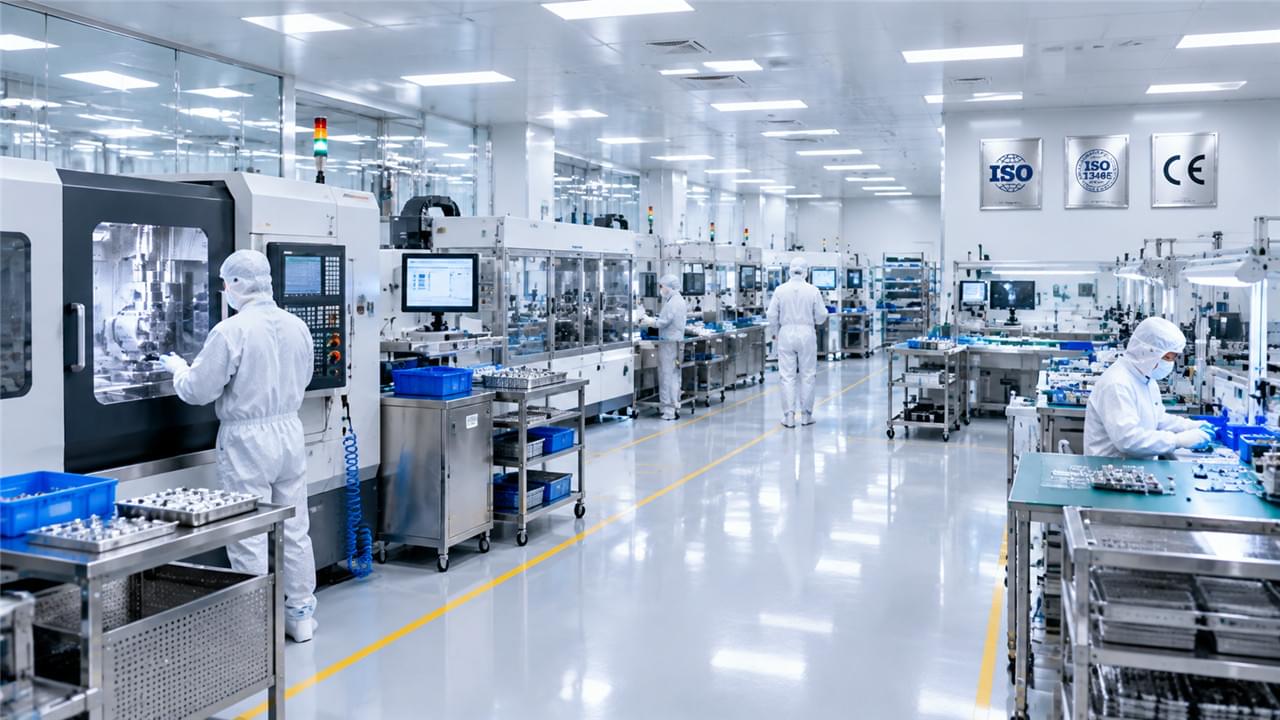
Vsun Medical runs two product families under one roof: medical devices — orthopedic power tools, external fixators, veterinary instruments — and pharmaceutical products, meaning empty capsules. Housing both in one plant demands strict separation, because the two categories don’t answer to the same rules.
Physical Layout for Cross-Contamination Prevention
Separation here is physical and procedural, not a line on an org chart:
- 🚪 Separate entrances and gowning areas for each manufacturing zone
- 💨 Dedicated HVAC systems with independent air handling and appropriate pressure differentials — so air moves where we tell it to
- 📦 Segregated raw material storage for metallic components on one side, pharmaceutical excipients (gelatin, HPMC, pullulan) on the other
- 🔬 Separate QC laboratories — dimensional and mechanical testing for devices; dissolution, microbial, and moisture testing for capsules
No shared corridors, no shared air, no shared benches. It sounds excessive until you consider what one stray gelatin particle means inside a machined instrument lot.
Cleanroom Classification at Our GMP Manufacturing Facility
Different products need different air. Our cleanroom map looks like this:
| Production Zone | ISO Class | EU GMP Grade | What Happens There |
|---|---|---|---|
| Capsule production | ISO Class 7 (Class 10,000) | Grade C | Forming, drying, inspection |
| Device assembly | ISO Class 8 (Class 100,000) | Grade D | Instrument assembly, packing |
| QC laboratory | ISO Class 7/8 | Controlled | Analytical testing |
| Packaging & labeling | Controlled (non-classified) | Cleanroom-equivalent | Secondary packaging |
Holding those classes takes more than a good filter. We run validated HEPA filtration — H14 in ISO 7 areas, H13 in ISO 8 — with continuous airborne particle monitoring and enforced gowning at every entry point. Settle plates and active air sampling run on a fixed schedule, and the results feed directly into batch release decisions.
For the pharmaceutical side, those expectations trace back to the WHO GMP guidelines, which set the baseline for cleanroom behavior worldwide.
🔧 Orthopedic Device Manufacturing: From Raw Bar to Finished Instrument
Now the devices. Every orthopedic power tool and external fixator component follows the same route through the plant.
Raw Material Incoming Inspection
Nothing enters production on trust. Metal bars, tubes, and sheets are inspected on receipt:
- 📜 Material certification verification — mill certificates confirming alloy composition: surgical-grade 316L stainless steel per ASTM F138, or titanium alloy per ASTM F136
- 📏 Dimensional sampling — CMM (Coordinate Measuring Machine) checks on cross-section dimensions
- 👁️ Surface condition — visual and tactile inspection for defects, corrosion, or contamination
- 🔒 Quarantine until released — material sits in quarantine until inspection is finished and documented. No paperwork, no production.
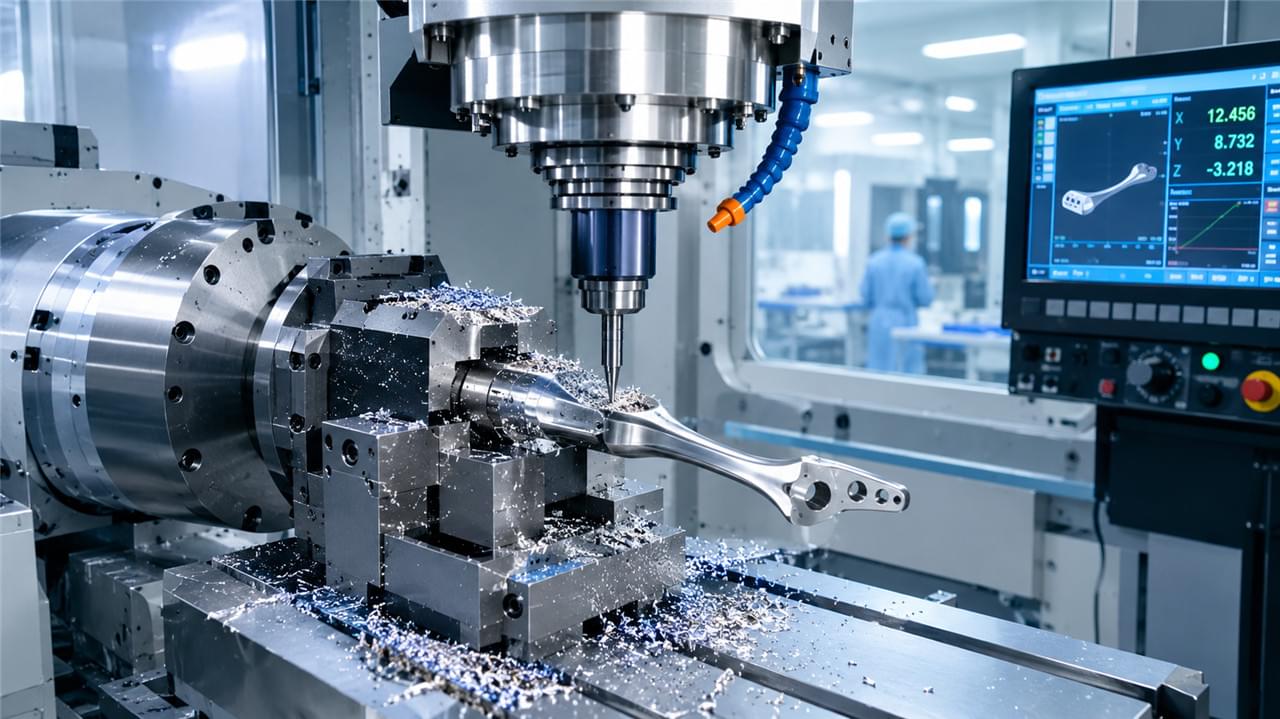
CNC Machining: Precision to ±0.01 mm
Components are cut on multi-axis CNC machining centers, with critical dimensions held to ±0.01 mm. That tolerance isn’t vanity — it’s what makes a chuck grip consistently, a pin holder hold accurately, and attachments interchange across batches.
Operators run dimensional checks at defined intervals using calibrated calipers and gauge blocks. Cutting tools are replaced on a scheduled cycle, because tool wear drifts dimensions long before it breaks anything.
Calibration underpins all of it. Measuring instruments — calipers, micrometers, gauge blocks, CMM probes — follow a traceable calibration schedule, and each one carries a label showing its next due date. An out-of-calibration gauge doesn’t just produce bad numbers; it produces confident bad numbers, which is worse. Every calibration event lands in the same document control system as the batch records.
Surface Treatment That Extends Instrument Life
Post-machining treatment does the quiet work of corrosion resistance and biocompatibility:
- ✨ Electropolishing — electrochemical surface removal that leaves stainless components microscopically smooth and oxide-rich
- 🛡️ Passivation — nitric acid treatment per ASTM A967, stripping free iron from the surface to maximize corrosion resistance
- 🟡 TiN coating (selected products) — PVD titanium nitride on drill bits and saw blades for hardness and edge retention
Then assembly, 100% functional testing of chuck mechanisms, speed control, and triggers, plus visual and dimensional final checks. If you want to see where the process ends up, the finished range sits in our product catalog.
💊 Pharmaceutical Capsule Manufacturing: No Shortcuts, Anywhere
Capsules look simple. They are not.
From Solution to Finished Shell
- 🧪 Solution preparation — pharmaceutical-grade raw materials from approved suppliers with full traceability, dissolved in purified water under controlled temperature and agitation, then verified for viscosity and concentration before a single pin enters the tank
- 📌 Pin dipping and shell formation — stainless steel pin bars coated at controlled dipping speed, dried in temperature- and humidity-controlled chambers, with multiple passes to build wall thickness to specification
- ✂️ Cutting, joining, and sorting — automated cutting to cap and body dimensions within ±0.05 mm
Inside Capsule Production at the GMP Manufacturing Facility
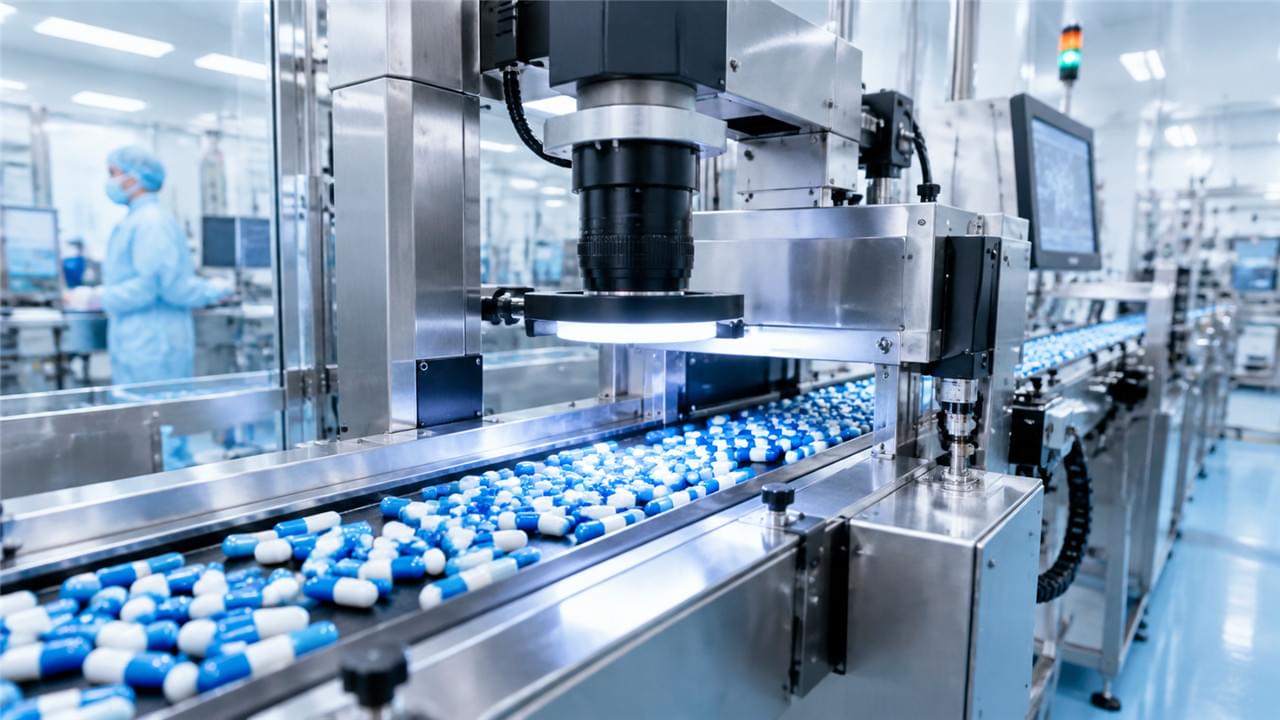
The stage that catches problems is inspection. Every capsule passes 100% automated optical inspection at full production speed — color, dimensions, surface defects, printing. Not a sample. Every one.
If you’re weighing capsule formats, sizes, or materials, our pharmaceutical empty capsules selection guide walks through the trade-offs between gelatin, HPMC, and pullulan.
Batch Release Testing: What Every Lot Must Pass
No batch leaves on a hunch. Mandatory QC release testing looks like this:
| Test | Method | Specification |
|---|---|---|
| Moisture content | Loss on Drying / Karl Fischer | Gelatin 13–16%; HPMC 4–6% |
| Disintegration | USP <701> | Per pharmacopoeial spec by type |
| Dimensions | Micrometer / caliper | Stated size ±0.05 mm |
| Weight uniformity | Balance weighing | Per specified range |
| Microbial count | USP <61>/<62> | TAMC ≤1000 CFU/g; TYMC ≤100 CFU/g |
| Pathogen absence | USP <62> | Absence of specified organisms |
Run-to-run consistency comes from validated processes with fixed parameter ranges, in-process controls at critical checkpoints, and statistical process control on key indicators. A good batch here isn’t luck — it’s repeatable.
✅ The 7 Quality Milestones Every Batch Must Clear
Here’s everything above in seven lines. Product leaves our GMP manufacturing facility only after clearing all seven:
- Material certification verified — mill certificates or supplier documentation confirmed against specification
- Incoming inspection passed — dimensional sampling and surface checks complete, material released from quarantine
- In-process controls hit — dimensional, viscosity, and process parameters recorded and inside range
- 100% inspection complete — full functional testing on instruments; optical inspection of every capsule
- Batch QC release passed — all pharmacopoeial or internal specifications met, with QC sign-off
- Documentation closed — batch record complete, reviewed, and approved
- Traceability retained — records filed and retrievable for regulatory audit
Fail any milestone and the batch doesn’t ship. That’s the whole system in seven steps.
📋 Documentation & Audit Readiness: Prove It, Don’t Just Promise It
Documentation: The Backbone of a GMP Manufacturing Facility
GMP lives or dies on records. Our quality management system is fully documented:
- 📄 Batch Manufacturing Records (BMRs) — raw material lot, process parameters, in-process results, and operator identification for every batch
- 🧾 Device History Records (DHRs) — full traceability from component manufacture through final product
- ✍️ QC release sign-off — no batch reaches inventory without it
- 🗂️ Document control — version history, approval records, and revision tracking on every procedure
For buyers, this maps to a standard you already recognize: the ISO 13485 medical device quality management standard, the framework our QMS is built around. A companion subject most buyers meet eventually is medical device international logistics — documentation has to travel with the goods, not after them.
Audit Readiness at Our GMP Manufacturing Facility
We’d rather you verify than take our word for it. We welcome supplier audits from qualified buyers, distributors, and regulatory bodies.
Ask, and we’ll send a pre-audit documentation package first:
- Current ISO 13485 certificate with scope statement
- GMP compliance self-assessment
- Facility floor plan
- Sample batch records, appropriately anonymized
- Environmental monitoring summary data (6-month rolling)
Then pick your format: a virtual video audit of 3–4 hours covering QMS documents and a live walk-through of the production floor, or a full-day on-site audit with QC laboratory access and record review. Most buyers begin with a virtual Vsun Medical factory tour, then travel to site once the commercial conversation gets serious.
Worth asking on any audit: what happens after the sale. Our 2-year warranty on orthopedic equipment exists because a warranty only means something when the manufacturing behind it is documented.
📬 Come See It for Yourself
Qualified buyers, distributors, and procurement officers are welcome to schedule a facility audit or virtual tour of our GMP compliant production facility. Bring your checklist — we like the hard questions.
MOQ questions welcome. We built our fulfillment capability specifically to serve the small-MOQ needs of distributors entering new markets, alongside established distributors with volume contracts. Tell us your product requirements and we’ll send current MOQ schedules and pricing tiers.
Schedule a Facility Audit → vsunmedical.com/contact
GMP Compliant · ISO Certified · 2-Year Warranty · Fully Auditable Supply Chain
 English
 Arabic
 German
 French
 Italian
 Spanish
 Russian
 Japanese
 Korean
 Turkish
 Portuguese