
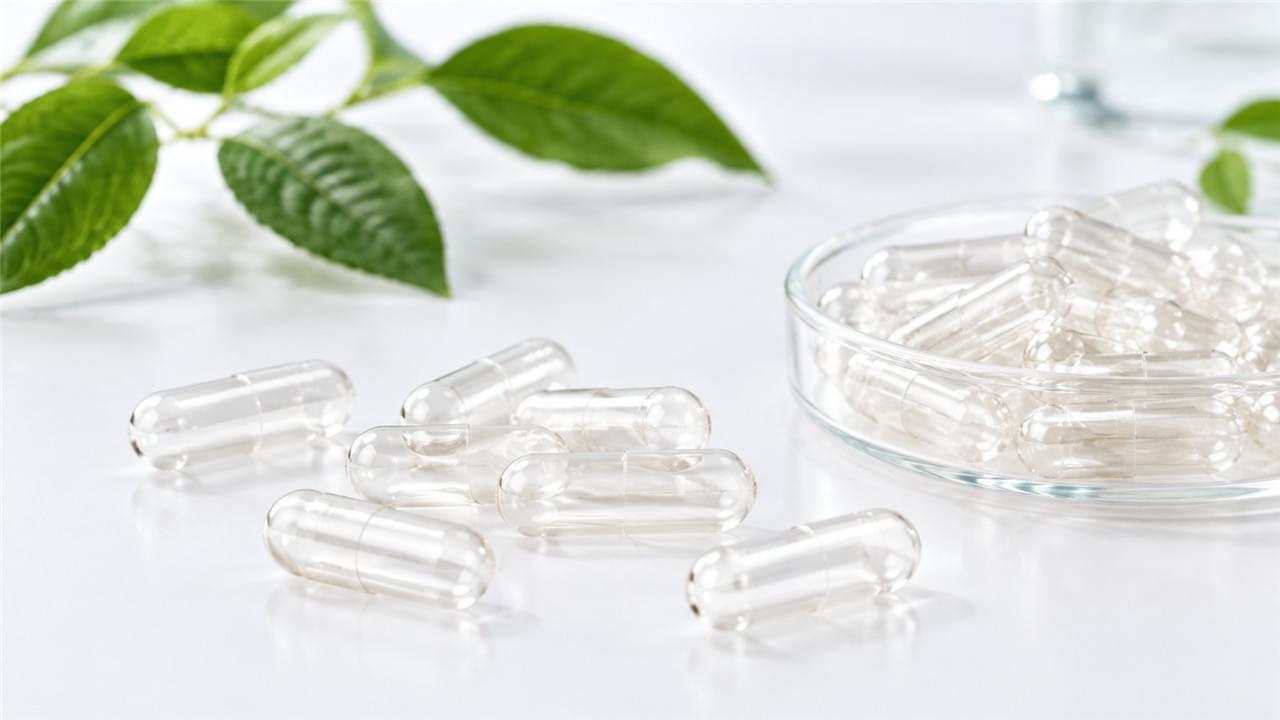
TL;DR: HPMC vegan capsules are plant-derived, completely free of animal products, and compatible with nearly every fill formulation on the market. 🌱 As veganism, halal certification demands, and clean label expectations accelerate worldwide, these gelatin-free shells are moving from niche alternative to the new pharmaceutical default. Here are the five reasons behind that shift — and what B2B buyers should check before switching. 📈
This article is part of our pillar guide: Plant-Based Capsule Market Trends: What Manufacturers Need to Know
🌿 From Niche to Norm
What Are HPMC Vegan Capsules?
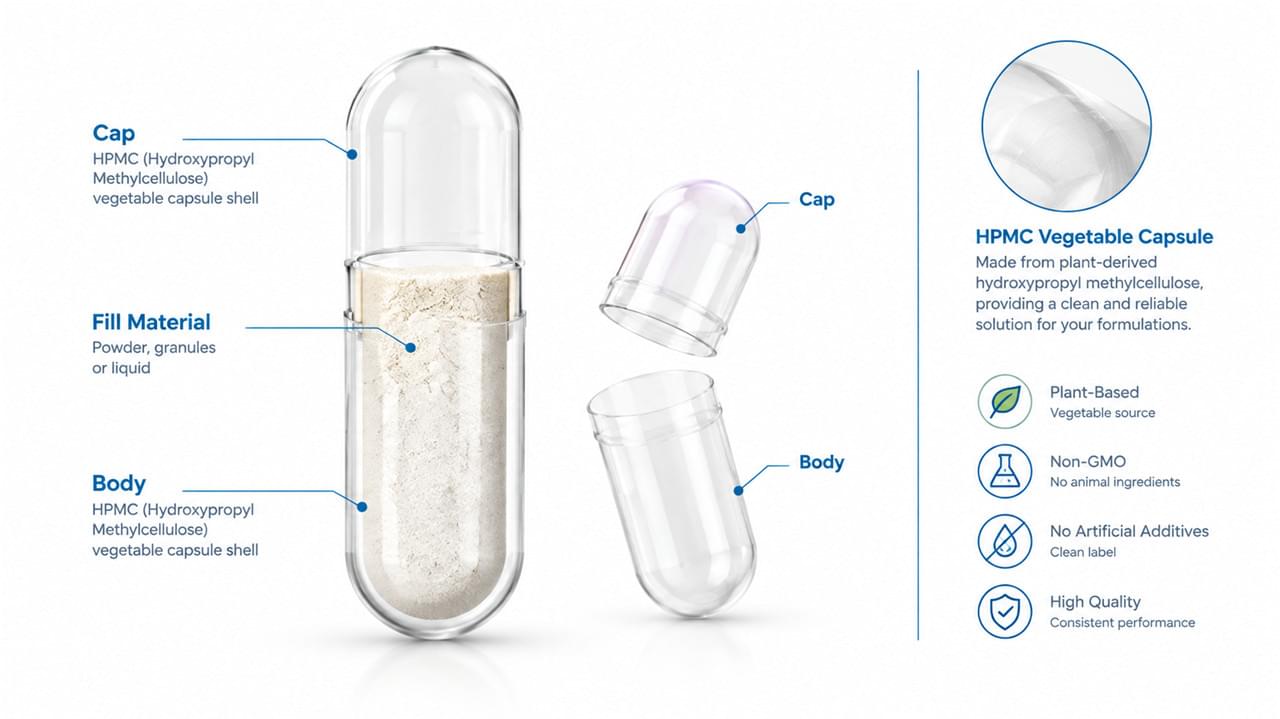
Hydroxypropyl methylcellulose (HPMC) capsules — also sold as vegetarian capsules — are two-piece hard shells derived entirely from cellulose, the structural polymer in plant cell walls. Unlike gelatin shells sourced from bovine or porcine collagen, they contain no animal-derived ingredients at all.
First launched commercially in the 1990s to serve vegetarians, vegans, and consumers observing halal and kosher dietary laws, they now run through nutraceuticals, pharmaceuticals, and OTC health products alike. What began as an accommodation for a dietary minority has become a mainstream sourcing requirement. 🌍
📈 Five Reasons the Market Is Shifting
Reason 1: Vegan and Vegetarian Growth Is Reshaping Demand
The number of people identifying as vegan or plant-based has grown by over 300% since 2012 in key markets (US, UK, Germany, Australia). This demographic reads labels — including the capsule shell. For supplement brands, offering a vegan capsule shell is no longer a courtesy; it is a prerequisite for mainstream retail distribution.
Reason 2: Why Halal Markets Choose HPMC Vegan Capsules
The halal pharmaceuticals market was valued at over USD 100 billion in 2023, spanning Southeast Asia, the Middle East, and Africa. A shell that cannot be certified is a market-access barrier — full stop. Plant-derived shells carry no animal-derived risk, which makes halal certified capsules dramatically simpler to document. Kosher buyers follow the same logic.
| Market Segment | Gelatin Barrier | Plant-Derived Advantage |
|---|---|---|
| Vegan / vegetarian | Incompatible | Fully compatible |
| Halal certified | Specific gelatin source + audit | Inherently compatible |
| Kosher certified | Specific audit required | Broadly compatible |
| Hindu / Jain markets | Bovine gelatin rejected | Fully accepted |
| Premium clean label | Perceived as “unnatural” | Consumer-preferred |
Reason 3: Clean Label Expectations Keep Climbing
Consumers want short, recognizable ingredient lists — and “gelatin (bovine)” is a line many now prefer to skip, whatever their dietary philosophy. HPMC appears on a label as a single plant-derived ingredient, recognized by the FDA, EMA, Health Canada, and NMPA as a safe excipient with no allergen concerns and a long safety record. 🏷️
Reason 4: Why HPMC Vegan Capsules Can’t Cross-Link
Gelatin has a well-documented flaw: cross-linking — a reaction between aldehydes (from certain fill materials or environmental contamination) and gelatin proteins that slows dissolution and can fail regulatory dissolution testing. Plant-derived shells contain no protein, so the reaction is chemically impossible. For formulations with aldehydes, reducing sugars, or Maillard-prone ingredients, that single fact decides the shell material. 🧪
Reason 5: Regulatory Documentation Gets Simpler
HPMC (E464) is listed in every major pharmacopoeia — USP/NF (USP hard capsules monograph), Ph. Eur., JP, and IP — and holds GRAS status in the US. For manufacturers exporting to multiple markets simultaneously, it eliminates one documentation variable entirely: no separate halal certificates for the shell, no animal-welfare paperwork. That streamlines market authorization across the EU, GCC, and ASEAN alike. 📜
🔬 Technical Advantages Beyond the Label
Moisture Behavior and Fill Compatibility
Gelatin shells need 35–65% RH to stay elastic; below that they turn brittle and crack. Plant-derived shells tolerate a far broader humidity band, staying stable through manufacturing, packaging, and global distribution. They remain compatible with dry powder blends, granules and pellets, oils and lipid formulations (with band sealing), low-water-activity materials, and hygroscopic actives.
Can they take oil-based fills? Yes, with proper band sealing between cap and body — standard practice for two-piece systems replacing softgels. One caveat: very high water-activity fills interact differently with cellulose shells than with gelatin, so formulators should validate fill-shell compatibility during development. 💧
Do they dissolve as fast as gelatin? Slightly slower under standard test conditions, but the difference is clinically insignificant for most oral dosage forms — and shell formulation can tune it. For critical bioavailability targets, run comparative dissolution testing during development.
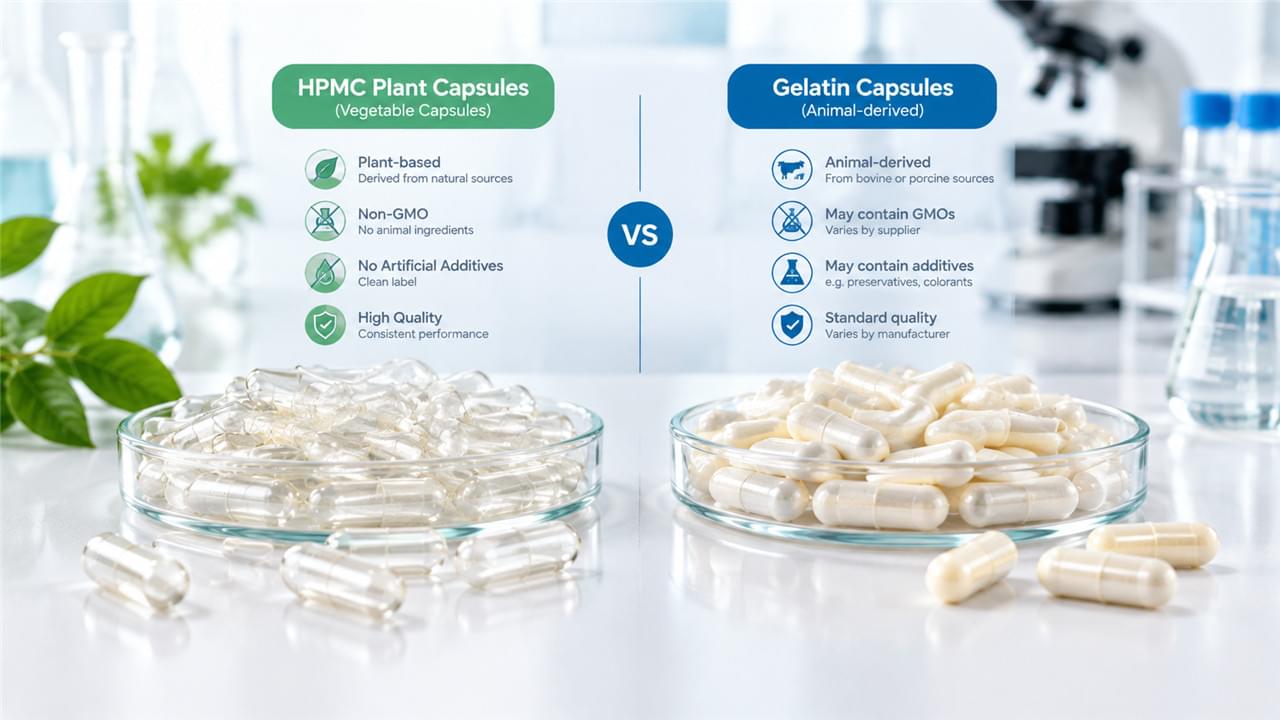
⚖️ HPMC vs. Gelatin: Head-to-Head
| Property | Plant-Derived Shell | Gelatin Shell |
|---|---|---|
| Source | Plant (cellulose) | Animal (bovine/porcine collagen) |
| Vegan / vegetarian | ✓ Yes | ✗ No |
| Halal compatible | ✓ Inherently | Requires sourcing audit |
| Cross-linking risk | None | Present under certain conditions |
| Humidity sensitivity | Lower | Higher |
| Dissolution rate | Slightly slower* | Faster |
| Fill compatibility | Very broad | Broad |
| Cost premium | ~15–30% above gelatin | Baseline |
*Dissolution can be optimized through shell formulation; the difference is clinically insignificant for most products.
Is the 15–30% premium worth it? For brands targeting vegan, halal, or clean label positions, routinely yes — the expanded addressable market and reduced certification complexity repay the differential. See our plant vs. gelatin stability comparison for the physical data. ⚖️
📊 Market Forecast: Share Keeps Shifting
The global hard capsule market is projected to grow at 7–8% CAGR through 2030, with the plant-based segment outpacing the whole. Analysts at Grand View Research have tracked consistent share gains across North America and Europe, with the fastest growth in Asia-Pacific markets where middle-class health consciousness is expanding. 📈
For buyers, the practical takeaway is simple: gelatin-free capsules are no longer a specialty order. Lead times have normalized, size ranges now mirror gelatin catalogs (000 through 5), and pricing keeps easing as production capacity comes online. Brands that qualified plant-derived suppliers two years ago are renegotiating from strength today — brands that waited are paying a late-mover premium in both price and shelf positioning.
The vegan capsule market sits at the leading edge of that curve, driven by nutraceutical growth, OTC brands repositioning for wellness buyers, private labels needing multi-market compatibility, and pharma reformulation away from animal-derived ingredients.
🏭 Vsun Medical HPMC Capsule Specifications
| Parameter | Specification |
|---|---|
| Material | Hydroxypropyl methylcellulose (HPMC) |
| Sizes available | 000, 00, 0, 1, 2, 3, 4, 5 |
| Moisture content | 4–8% |
| Standard colors | Clear, opaque white, custom options |
| Certifications | GMP, ISO compliant |
| Halal/Kosher compatibility | Yes |
| MOQ | Flexible — contact for quote |
| Shelf life | 24 months under proper storage |
🛒 Sourcing Checklist for B2B Buyers
How to Source HPMC Vegan Capsules Without Surprises
For distributors, OEMs, and pharmaceutical companies evaluating suppliers:
- 📄 Request a Certificate of Analysis — moisture content, dimensions, disintegration time, microbial limits
- 🏭 Confirm GMP compliance — ask for facility certification documentation
- 🧪 Validate fill compatibility — get empty shell samples to your formulation team
- 📦 Confirm packaging options — bulk polyethylene bags, blister, or strip pack for your logistics chain
- 📏 Assess MOQ flexibility — low MOQ suppliers cut capital exposure for emerging brands
On safety, the record is settled: HPMC is listed across USP/NF, Ph. Eur., and JP as a safe excipient with worldwide regulatory acceptance. For global regulation specifics, see our plant capsule regulations overview. ✅
📦 Ready to Switch?
Vsun Medical supplies GMP-compliant HPMC vegetable capsules to pharmaceutical manufacturers, supplement brands, and distributors worldwide — plant-based and halal-compatible, all standard sizes (000–5), flexible MOQ for startups and scale-ups, a 2-year quality warranty, and fast global logistics via DHL/FedEx.
Request a Free Sample & Quote → vsunmedical.com/contact
Qualified B2B buyers can request sample quantities with a full certificate of analysis.
Browse the complete empty capsule product line to compare HPMC and pullulan options for organic supplements.
 English
 Arabic
 German
 French
 Italian
 Spanish
 Russian
 Japanese
 Korean
 Turkish
 Portuguese