
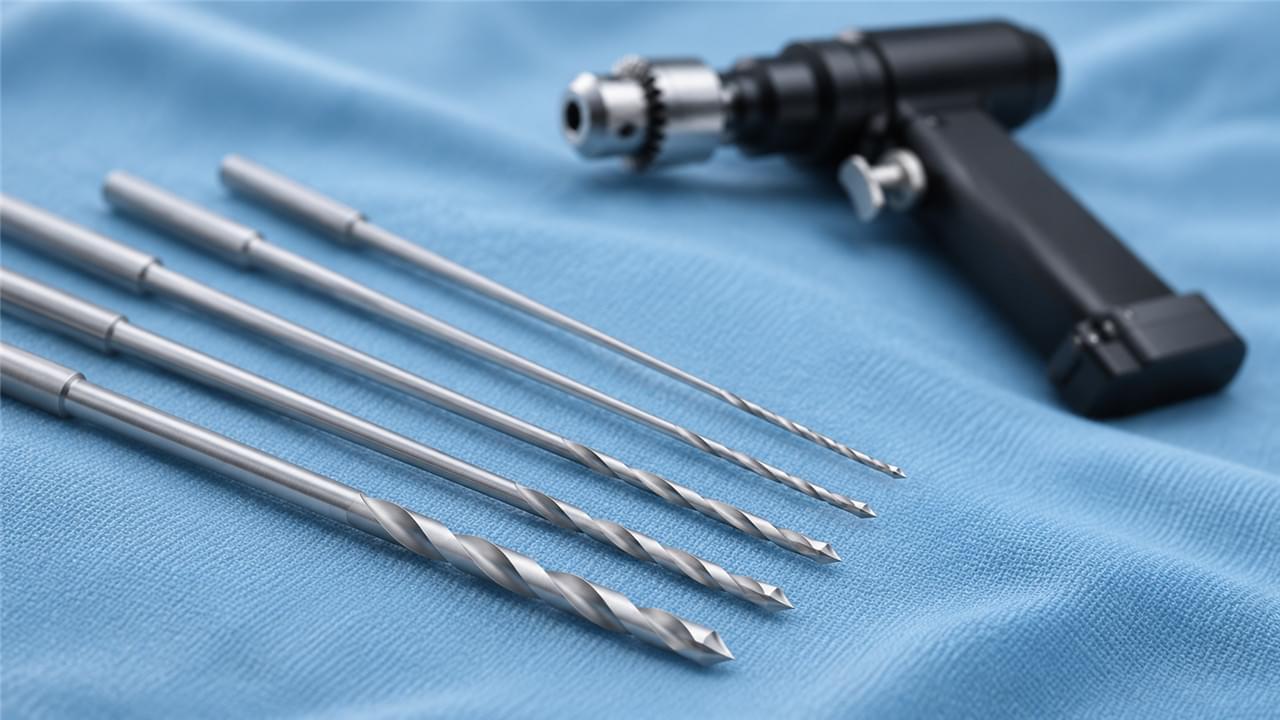
TL;DR: Small diameter drill bits — typically 1.0mm to 4.5mm — are the foundational instruments that make minimally invasive orthopedics possible. Their design has to balance cutting efficiency, heat control, minimal tissue displacement, and durability under genuinely punishing surgical conditions. This guide walks through the engineering principles, clinical applications, and selection criteria behind modern MIS drill bits — the details that decide whether a 2mm bit holds its trajectory or wanders off plan.
The MIS Imperative: Why Drilling Gets Harder Through a Portal ⚠️
In minimally invasive surgery, the operative corridor is constrained by design. Surgeons work through incisions that sometimes measure just 1–3 cm, and every instrument entering that corridor must do its job with minimal collateral impact.
Drill bits feel this constraint hardest. In open surgery, the surgeon directly visualizes the drilling field and adjusts by eye and feel. In MIS, drilling runs on fluoroscopy, navigation, or tactile feedback through narrow channels — and the bit itself must be engineered to compensate for everything the surgeon cannot see. A wandering tip or an overheating flute is not a minor annoyance; it is a failed fixation.
This article is part of our in-depth series on MIS technology. For the full instrumentation picture, start with the pillar guide: Minimally Invasive Surgery Power Tools Innovations.
Sizing It Up: What Counts as “Small Diameter”? 📐
The Diameter Map for MIS Drill Bits 📐
Orthopedic drilling spans a huge range, and “small” means something specific:
| Category | Diameter Range | Primary Applications |
|---|---|---|
| Micro / small | 1.0 – 2.5 mm | Hand fractures, foot/ankle, pediatric bone, percutaneous fixation |
| Standard MIS range | 2.5 – 4.5 mm | Cannulated screw pilot holes, arthroscopic access, pedicle preparation |
| Standard open surgery | 4.5 – 14 mm | Hip, knee, shoulder arthroplasty; shaft fractures |
| Large diameter | >14 mm | Reaming, acetabular preparation |
MIS work concentrates in the 2.0–4.5mm band. Percutaneous screw fixation of scaphoid fractures, minimally invasive plate osteosynthesis (MIPO), and endoscopic spine procedures all demand this caliber of instrument.
The Engineering That Decides Performance 🔧
Flute Geometry: Where MIS Drill Bits Win or Fail 🌀
The flute — the helical channel running the bit’s length — decides how bone chips evacuate from the cutting zone. At small diameters, three variables fight for the same millimeters:
- Cutting edge angle: sharper (lower rake) angles cut with less force but generate more heat; steeper angles cut faster and cooler but risk chatter at micro scale
- Flute depth: deeper channels clear bone faster but weaken cross-sectional rigidity — a real concern when bending moment is already marginal
- Helix angle: typically 25–35° for bone, governing chip evacuation speed
Key principle: at small diameters the optimization window is narrow. A 0.1mm variation in tip geometry can meaningfully shift both cutting efficiency and heat output.
Material Science: What These Bits Are Made From
| Material | Characteristics | Typical Application |
|---|---|---|
| 17-4 PH Stainless Steel | Corrosion resistant, reusable, moderate hardness | General orthopedic drilling |
| High-speed steel (HSS) | Affordable, good toughness | Basic reusable instruments |
| Titanium alloy (Ti-6Al-4V) | Lightweight, MRI-compatible, strong | Navigation-guided MIS |
| Cobalt-chrome alloy | Very hard, excellent wear resistance | High-cycle drilling |
For small-diameter precision work, titanium alloy and premium stainless steel dominate. Titanium’s low weight also reduces the gyroscopic feedback transmitted to the surgeon’s hand through narrow cannulas — a subtle but real ergonomic advantage.
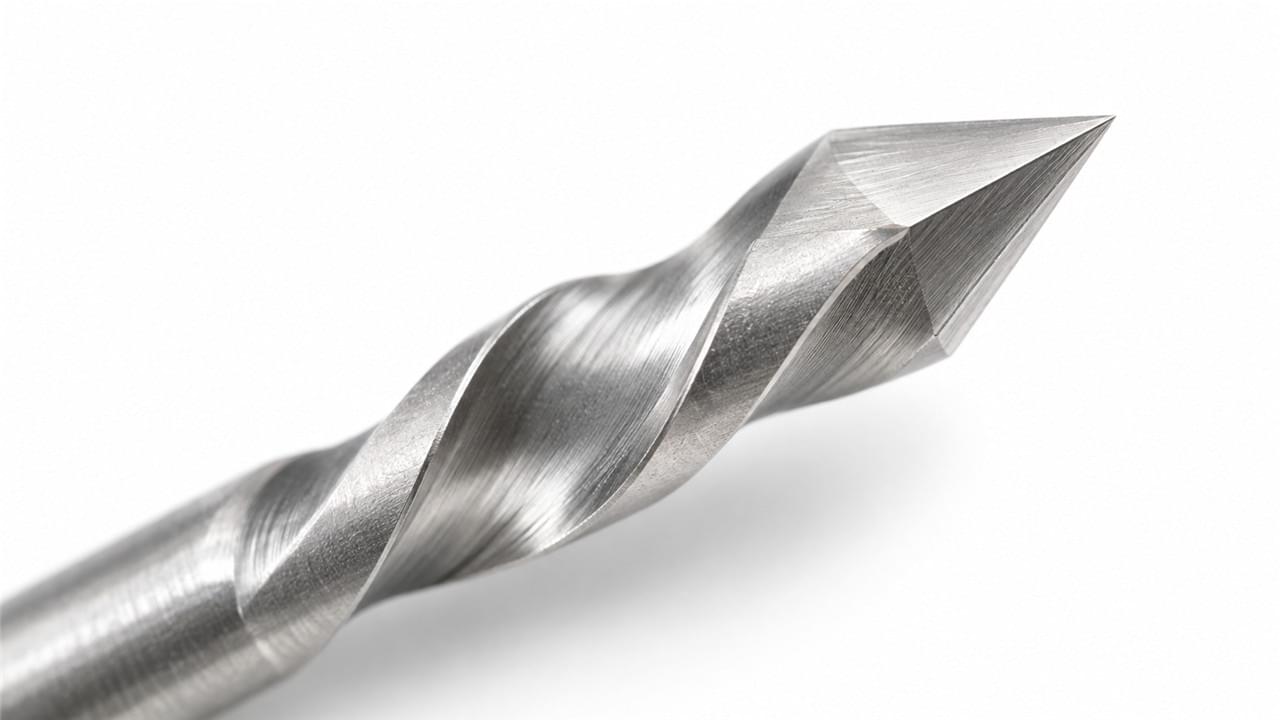
Point Geometry and Bone Entry
The tip decides how cleanly the bit enters cortical bone:
- Trocar tip (three-facet): aggressive entry, best in dense cortical bone
- Split point: self-centering, eliminates “walking” or lateral drift — critical when the bit must follow a precisely planned trajectory
- Conical tip: smooth entry for cancellous approaches
Where trajectory accuracy is non-negotiable — pedicle screw placement, percutaneous sacroiliac fixation — self-centering split-point geometry is the preferred answer.
Heat: The Invisible Enemy 🌡️
Sharpness: The Make-or-Break Factor for MIS Drill Bits 🔪
Heat generation is a function of cutting speed, applied force, and thermal conductivity of bone and bit. Three realities shape MIS drilling:
- Higher rotational speeds produce more heat per second but finish cuts faster, limiting cumulative energy transfer
- Irrigation is the primary heat management strategy — yet access is exactly what MIS corridors restrict
- Sharpness has a disproportionate impact: a dull bit needs more force and generates far more frictional heat
At small diameters the contact-surface-to-bone-volume ratio climbs, so heat concentrates per unit area. Thermal osteonecrosis — bone cell death from heat — can compromise both implant fixation and healing. That leaves three non-negotiables: bits must be extremely sharp at time of use, fed at controlled rates, and replaced on disciplined intervals (single-use or validated reuse cycles). The physics is covered in depth in our guide to thermal control in MIS drilling.
Single-Use vs. Reusable: The Procurement Decision ♻️
| Parameter | Single-Use | Reusable |
|---|---|---|
| Sharpness at use | Always factory-fresh | Degrades with reprocessing |
| Sterilization burden | None | Full reprocessing required |
| Cost per procedure | Higher per unit | Lower amortized cost |
| Cross-contamination risk | Eliminated | Requires validated reprocessing |
| Regulatory trend | Growing preference (especially EU) | Traditional standard |
Under EU MDR, the momentum favors single-use devices wherever reprocessing validation gets complex — and small-diameter precision bits sit squarely in that category.
Practical buyer tip: whichever route you choose, demand the manufacturer’s sharpness degradation data for reusable bits, and for single-use bits confirm lot traceability comes standard with every shipment. Both documents decide how smoothly your quality audits run.
The Cannulation Standard: Working Without Direct Vision 🧭
Cannulated MIS Drill Bits: Following the Wire 🎯
Cannulated drill bits — hollow down the center — are the standard for most MIS screw fixation. The cannula lets the bit follow a guide wire placed under fluoroscopic or navigation guidance, which delivers:
- Precise trajectory control without direct visual access
- Wire first, confirm radiographically, then drill in one controlled pass
- Simultaneous irrigation through the cannula in some designs
For percutaneous fixation of hip fractures, scaphoid fractures, tibial plateau fractures, and spinal procedures, this design is essentially universal.
How Vsun Medical Approaches Small Diameter Design 🏭
Our orthopedic power tool accessories include a range of small-diameter bits engineered specifically for MIS. Design priorities:
- Tight dimensional tolerances (±0.02mm on diameter)
- Split-point tip geometry for self-centering entry
- Optimized flute geometry for efficient chip clearance
- Medical-grade materials with full traceability
- Compatibility with standard and cannulated guide wire systems — see the Orthopedic Power Tools platform and our portable MIS tool lineup
Expert perspective — Vsun Medical Engineering Team: “When we design a 2.5mm cannulated bit for percutaneous fixation, tip geometry and flute symmetry have to hold to watchmaker standards. At that scale, asymmetry creates lateral forces that push the bit off trajectory — completely unacceptable when the surgeon cannot directly correct for it.”
Clinical technique context: the AO Foundation surgical reference and the FDA 510(k) database are the two authorities worth consulting when drafting specifications.
Get Bits That Hold Their Trajectory 🚀
Vsun Medical engineers small-diameter MIS drill bits to the tolerances modern minimally invasive orthopedics demands.
- ✅ 1.0mm – 14mm diameter range
- ✅ Cannulated and solid options
- ✅ Split-point and trocar tip geometry
- ✅ Medical-grade stainless steel and titanium alloy
- ✅ GMP-manufactured, ISO-certified
Request Catalog & Technical Specifications →
FAQ
Q1: What diameter range counts as typical for MIS orthopedic drilling?
Most percutaneous fixation and arthroscopic applications run 2.0–4.5mm. Micro applications — hand, foot/ankle, pediatric — may use bits as small as 1.0–1.5mm.
Q2: Why does sharpness matter so much at small diameters?
Cutting forces concentrate over a tiny area. A dull bit needs more force to remove the same bone volume, and that extra work converts into frictional heat — which drives thermal osteonecrosis, impairing healing and fixation. Factory-fresh sharpness is a safety requirement, not a luxury.
Q3: What is a cannulated drill bit and why does MIS prefer it?
It has a hollow central channel that threads onto a guide wire. The wire is placed under fluoroscopic guidance to establish trajectory; the bit then follows the wire precisely — accurate drilling without direct visualization of the field.
Q4: Should these bits be single-use or reusable?
Both exist in clinical practice. Single-use guarantees factory-fresh sharpness per procedure at higher unit cost; reusable offers lower amortized cost but demands validated reprocessing and sharpness inspection. EU and several other markets lean single-use for complex MIS instruments.
Q5: Are Vsun Medical bits compatible with specific power tool systems?
Our bits use standard interface compatibility. Send our sales team your power tool system specifications and we will confirm fit and discuss custom options.
Published by Vsun Medical | GMP-Certified Capsule & Surgical Equipment Manufacturer
 English
 Arabic
 German
 French
 Italian
 Spanish
 Russian
 Japanese
 Korean
 Turkish
 Portuguese