
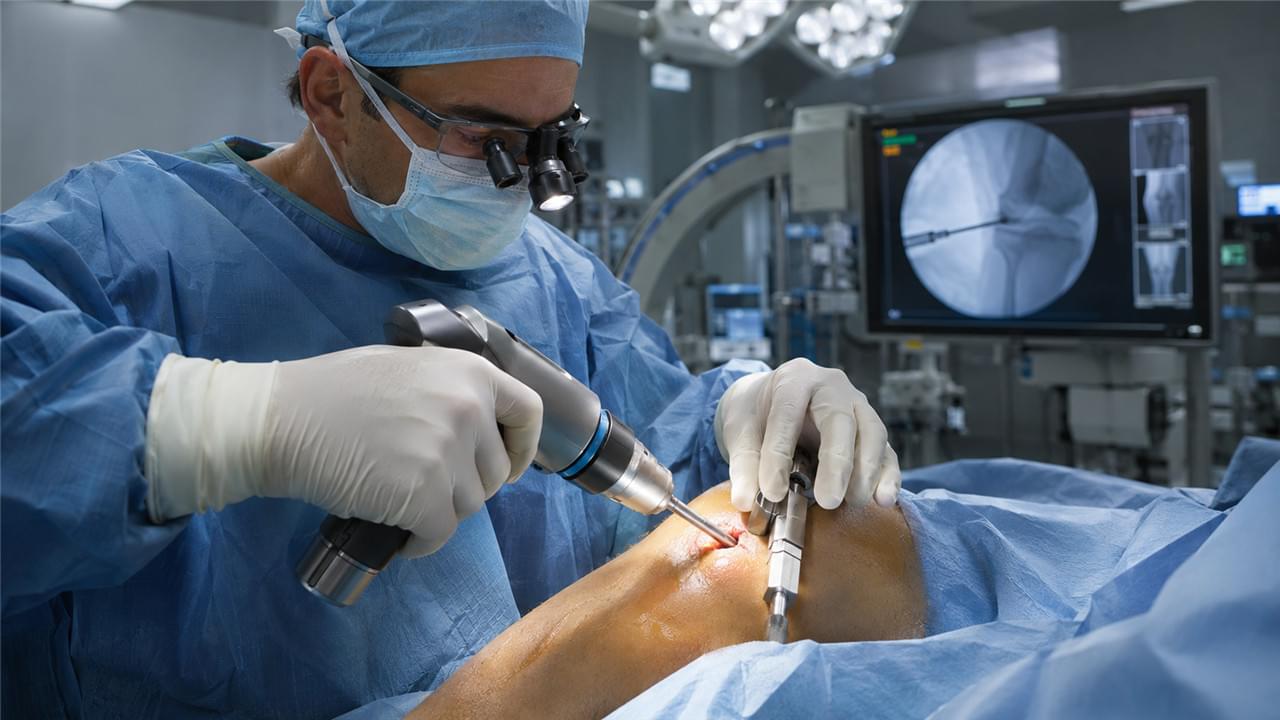
TL;DR: Minimally invasive surgery has transformed orthopedics — smaller incisions, less tissue trauma, faster recovery. But MIS power tools carry the burden of that transformation: they must be more precise, more compact, and more reliable than their open-surgery counterparts. This guide maps the five innovations driving the next generation — miniaturization, smart sensor feedback, heat management, battery optimization, and navigation integration. Whether you are a surgeon, hospital technology director, or procurement specialist, here is where the instrumentation is heading.
What Is Minimally Invasive Surgery (MIS)? 🔬
Definition: Minimally invasive surgery is a surgical philosophy built on performing procedures through the smallest possible incisions, using specialized instruments and imaging guidance to reach the same therapeutic goals as open surgery — with less tissue disruption, less blood loss, less postoperative pain, and faster recovery.
In orthopedics, modern MIS orthopedic techniques include:
- Percutaneous fracture fixation: pins and screws placed through small stab incisions under fluoroscopy
- Arthroscopic surgery: joint procedures through portal incisions with an arthroscope
- Minimally invasive joint replacement: smaller exposures for hip and knee arthroplasty
- Percutaneous spine surgery: pedicle screws and interbody devices placed through tubular retractors
MIS is not one technique — it is a spectrum of reduced-access approaches sharing one hard requirement: instruments that perform through limited visual and physical access.
The Challenge: Why MIS Demands Better Power Tools ⚠️
Every constraint in the table below pushes engineering harder:
| Challenge | Open Surgery | MIS |
|---|---|---|
| Visual access | Direct visualization | Fluoroscopy (2D image only) |
| Working corridor | Wide (5–15 cm incision) | Narrow (5–8 mm portal) |
| Tool manipulation | Free hand movement | Constrained by portal geometry |
| Temperature control | Natural heat dissipation | Limited irrigation; confined space |
| Depth perception | 3D direct vision | Reconstructed from 2D fluoroscopy |
| Error margin | Wider — surgeon sees and corrects | Narrower — errors harder to detect |
These constraints mean that MIS power tools must be smaller, more precise, more intuitive, and more fail-safe than open-surgery instruments. That pressure is exactly what produced the five innovations below.
The 5 Innovations Driving the Next Generation 🚀
Innovation 1: Miniaturization — Compact High-Torque MIS Power Tools 📏
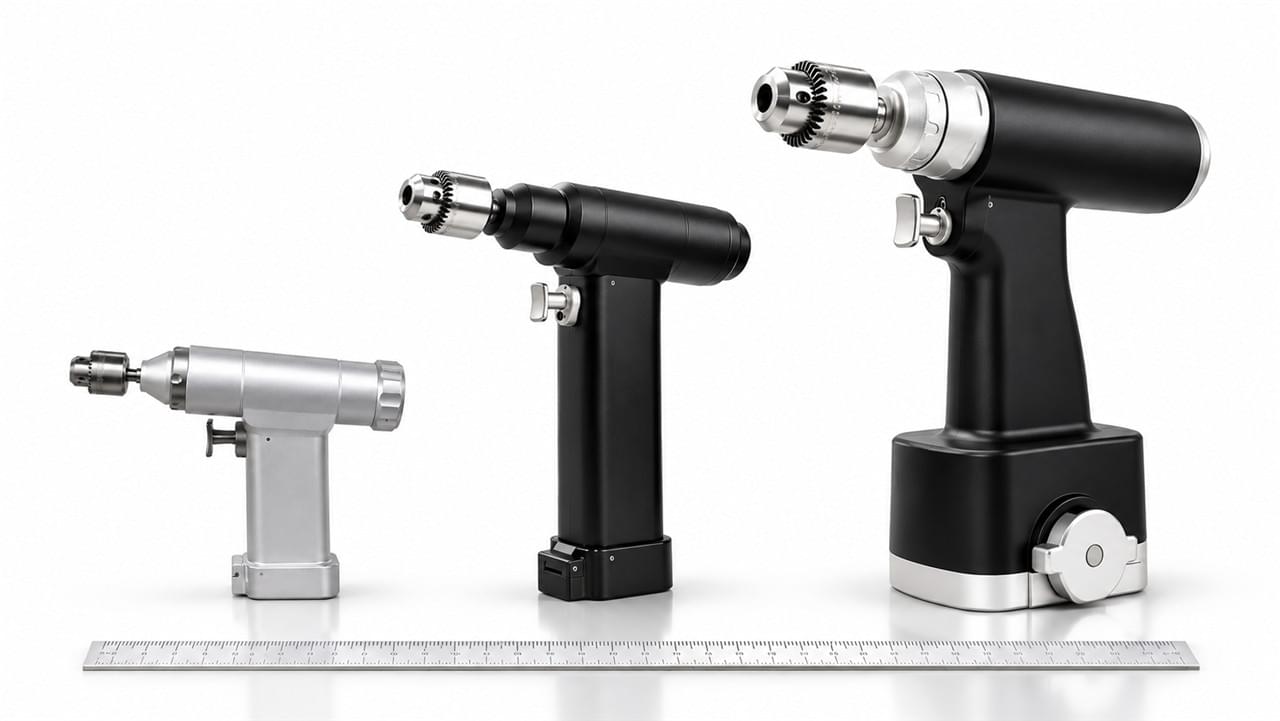
The most visible shift is the dramatic reduction in handpiece size while torque output holds or grows. Four technologies made it possible:
- High-density rare-earth magnets: NdFeB permanent magnets enable compact, high-power-density motors
- Planetary gear reduction: multi-stage gears deliver high torque at low output speed inside small housings
- Integrated electronics: surface-mount technology shrinks motor control circuitry into the handpiece itself
- Sealed bearing systems: miniature sealed bearings remove lubrication access requirements
Size Reduction Milestones
| Era | Handpiece Diameter | Torque Capability |
|---|---|---|
| 2000–2010 | 25–35 mm | Moderate |
| 2010–2020 | 20–28 mm | High (electronic regulation) |
| 2020–2026 | 15–22 mm | Very high (NdFeB motors) |
| Emerging | 10–15 mm | Adequate for specific MIS procedures |
The practical impact: today’s compact handpieces fit through arthroscopic portals and small incisions that earlier generations could not — enabling approaches that were technically infeasible a decade ago. For a technique-level view, see our guide to cannulated drills in minimally invasive surgery.
Innovation 2: Smart Sensors Inside MIS Power Tools 🧠
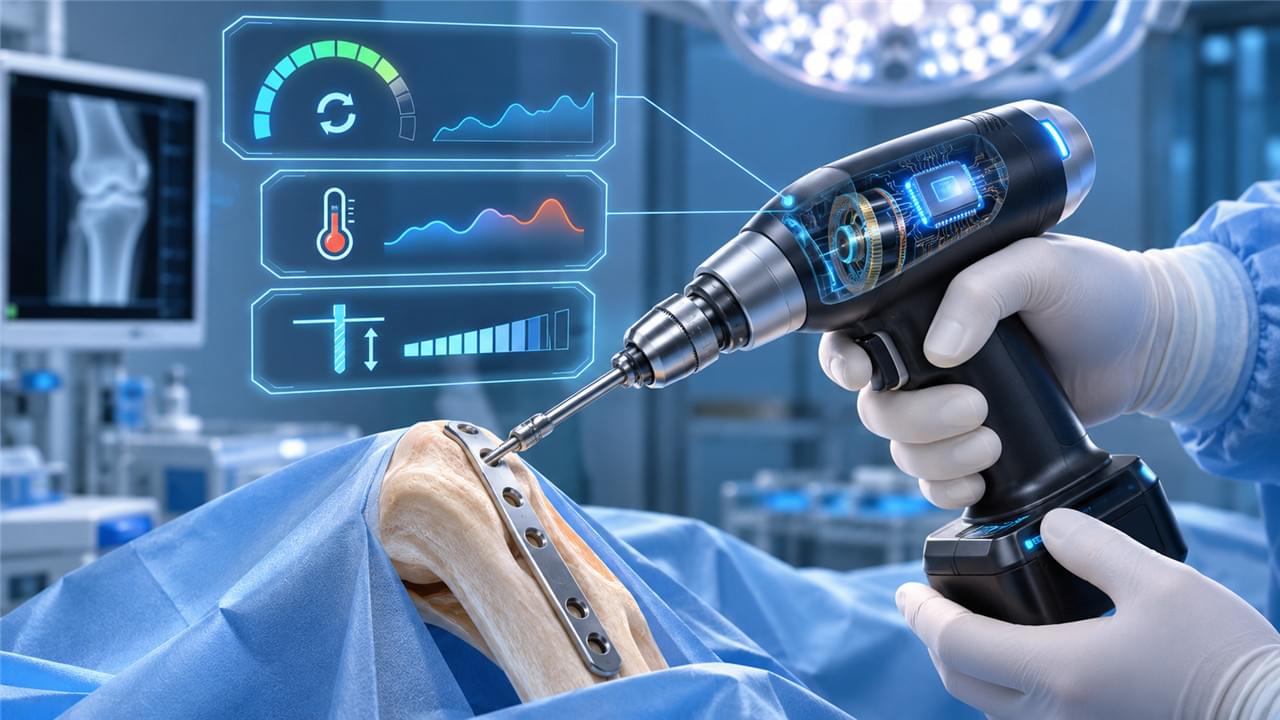
Definition: a smart surgical tool incorporates sensors and microprocessor feedback that give the surgeon real-time data on drilling parameters, bone density, and safety thresholds.
| Sensor Type | Function | Clinical Value |
|---|---|---|
| Torque sensing | Real-time load measurement | Detects cortical breakthrough; prevents plunging |
| Bone density estimation | Impedance measurement during drilling | Adapts speed and feed to bone hardness |
| Temperature sensing | Drill tip temperature | Prevents thermal osteonecrosis |
| Depth measurement | Integrated distance sensor | Alerts before the far cortex |
| Vibration analysis | Harmonic frequency analysis | Predicts dull blade or drill condition |
| Breakthrough detection | Sudden load change detection | Automatic speed reduction at far cortex |
How It Works: The Torque Sensing Example
During bone drilling, the motor controller tracks the current drawn by the motor — which correlates with torque load at the bit. The load profile tells the story:
- Cortical entry → sharp torque increase
- Cancellous passage → moderate torque
- Far cortex approach → torque rises again
- Far cortex penetration → sudden torque drop
The controller detects that final drop and automatically reduces speed or fires an alert — stopping the surgeon from driving the bit into soft tissue beyond the far cortex, a serious complication when direct visualization is limited.
Innovation 3: Heat Management — Beating the 47°C Threshold 🌡️
Thermal damage is a bigger threat in MIS than in open surgery: the confined corridor limits irrigation, and the surgeon cannot see heat effects on bone. Four technologies answer it:
- Integrated irrigation channels: modern handpieces deliver saline directly to the drill tip — no separate tube cluttering the field
- Automatic pulsed drilling: smart controllers alternate 3–5 seconds of drilling with 1–2 seconds of retraction for passive cooling
- Optimized flute geometry: three-flute, asymmetric-helix bit designs improve chip evacuation and cut heat per unit of bone removed
- Temperature feedback control: where tip sensing exists, the controller adjusts drilling speed on live readings
The number to remember: research consistently identifies 47°C held for over 60 seconds as the threshold for irreversible thermal osteonecrosis. Every design choice above exists to keep bone below it. Deeper dive: thermal control in MIS drilling.
Innovation 4: Battery Systems — Cordless Freedom Without Compromise 🔋
MIS procedures demand cordless operation — no pneumatic hoses threading through a constrained field — plus enough runtime for complex, multi-step cases. Three advances deliver it:
- High energy-density Li-ion cells: current cells carry 20–30% more energy per unit weight than a decade ago
- Smart battery management: microprocessor-controlled charging extends cycle life past 500 cycles
- Unified battery platforms: one battery runs the drill, saw, reamer, and wire driver — cutting inventory complexity
- Quick-swap design: batteries exchange mid-procedure without powering down the control unit
Full engineering story: battery technology in modern surgical power tools.
Innovation 5: Navigation — Where MIS Power Tools Meet Imaging 🗺️
The frontier is convergence with surgical navigation systems:
- An optical or electromagnetic navigation system tracks the patient’s anatomy and the instruments in 3D space
- A reference frame attaches to the bone
- The power tool carries a navigated attachment or built-in tracker
- The display shows the drill’s real-time position against the planned surgical path
Clinical value: the surgeon sees exact trajectory and depth on a 3D model — finally compensating for the 2D-only fluoroscopy view that defines MIS visualization limits. Navigation-integrated tools are commercially established in spine surgery and joint replacement, expanding into trauma and deformity correction. Next on the roadmap: AR overlays of virtual drill paths, AI-assisted planning, and robot-assisted drilling under human supervision.
Traditional vs. Modern: The Side-by-Side View ⚖️
| Feature | Traditional Open Tool | Modern MIS Power Tool |
|---|---|---|
| Handpiece diameter | 25–35 mm | 15–22 mm |
| Cordless operation | Optional | Standard |
| Speed regulation | Manual throttle | Electronic programmable |
| Sensor feedback | None | Torque, temperature, depth |
| Irrigation integration | External tube | Internal channels |
| Navigation compatible | No | Emerging standard |
| Sterilization | Autoclave | Autoclave + battery (plasma) |
| Weight | 400–700 g | 250–500 g |
The contrast is stark — and it explains why procurement teams now treat precision surgical power tools as a platform decision, not a per-item purchase. Compare power sources in our pneumatic vs. electric tools breakdown.
The 5-Year Outlook 🎯
Vsun Medical R&D Engineering Team:
“Three technology trajectories will define this category through 2031: sensor integration moves from premium to standard — torque and temperature sensing become table stakes; navigation compatibility becomes an expectation of major health systems for spine and arthroplasty platforms; and single-use disposable drill and saw systems gain share as infection control economics get properly counted. Our product road map addresses all three.”
When drafting tender requirements, it pays to anchor specifications in authority guidance — review AAOS minimally invasive orthopedic surgery resources and AAMI surgical power tool standards before finalizing procurement criteria.
For the complete landscape, start with the Orthopedic Power Tools Complete Guide.
MIS Power Tools Built for Precision Programs 🚀
Vsun Medical orthopedic power tools — compact, battery-powered, and GMP-manufactured — are built for the precision demands of minimally invasive orthopedic surgery. ISO certified with a 2-year warranty.
- ✅ Compact cordless handpieces for portal-based approaches
- ✅ Electronic speed regulation and quick-change attachments
- ✅ GMP-compliant manufacturing, ISO certified
- ✅ Sample and specification support for procurement teams
Request MIS Tool Specifications →
GMP Compliant · ISO Certified · 2-Year Warranty · MIS Precision Design
FAQ
Q1: What is the main advantage of smart sensor technology in MIS instruments?
Real-time feedback on conditions the surgeon cannot directly observe through a small incision. Torque sensing detects cortical breakthrough to prevent plunging, temperature sensing guards against thermal bone damage, and depth measurement avoids over-drilling — together they compensate for the limited visualization inherent in MIS.
Q2: Are navigation-integrated tools available for all MIS orthopedic procedures?
Not yet. Navigation integration is most mature in spine surgery (pedicle screw placement) and joint replacement (component positioning), with trauma and deformity correction expanding. Reference frame placement and CT/MRI pre-operative planning add setup time but materially improve accuracy in complex cases.
Q3: How does thermal management in MIS compare to open surgery?
It is harder: confined corridors limit irrigation flow at the drill-bone interface, heat effects on bone stay invisible, and drilling often runs deeper with less cooling access. Internal irrigation channels, pulsed drilling, and temperature feedback close the gap — but surgical vigilance remains essential.
Q4: Is Vsun Medical developing smart sensor technology for its tools?
Vsun Medical invests continuously in product development aligned with market trends. The current MIS platform offers electronic speed regulation, quick-change attachments, and compact cordless designs, with sensor integration and navigation compatibility on the development road map.
Published by Vsun Medical | GMP-Certified Capsule & Surgical Equipment Manufacturer
 English
 Arabic
 German
 French
 Italian
 Spanish
 Russian
 Japanese
 Korean
 Turkish
 Portuguese