
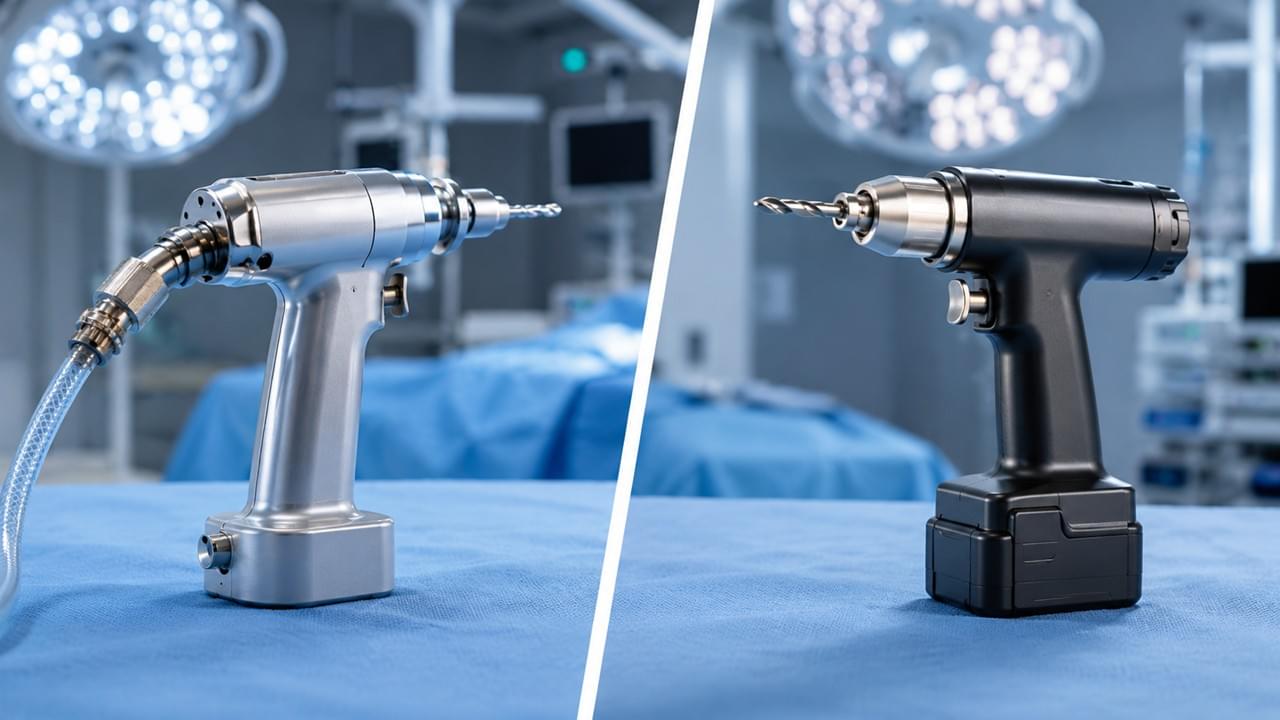
Part of our expert series: Orthopedic Power Tools: The Complete Guide to Surgical Drills, Saws & Systems
Quick Overview 🔍
Choosing between pneumatic vs electric orthopedic power tools is no longer a simple procurement decision. Hospitals, ambulatory surgery centers, and veterinary facilities now evaluate surgical systems based on torque precision, sterility, workflow efficiency, maintenance requirements, and long-term operating costs.
Both pneumatic and electric systems remain widely used in orthopedic surgery. However, advances in lithium-ion battery technology and electronic speed control have significantly changed purchasing preferences in recent years.
This guide compares both technologies across eight essential performance categories to help procurement teams, biomedical engineers, and surgeons identify the most suitable system for their operating environment.
Understanding the Two Surgical Power Systems
⚙️ How Pneumatic Orthopedic Power Tools Operate
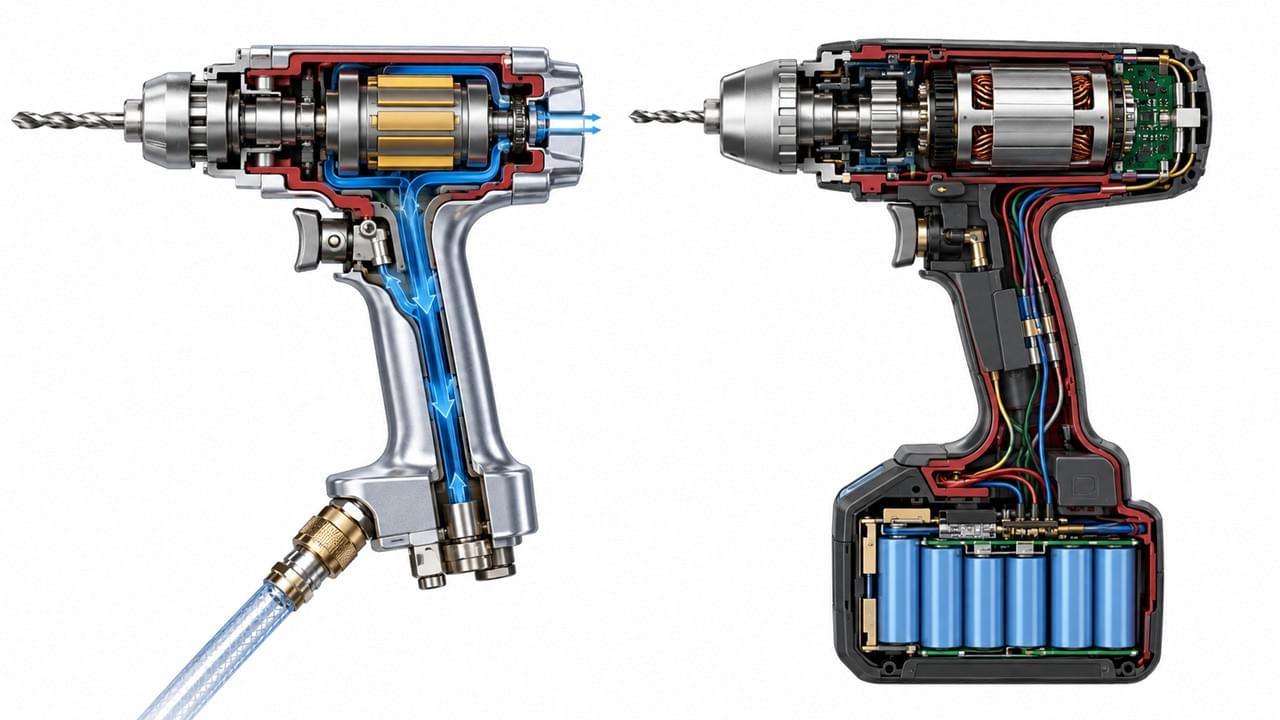
Pneumatic orthopedic drills and saws use compressed air supplied through a hospital’s central air infrastructure or portable air tanks. The compressed air enters the handpiece through a sterile hose and powers an internal vane or turbine motor.
Key Characteristics of Pneumatic Systems
- Operating pressure typically ranges from 90–120 PSI
- Trigger-based airflow controls rotational speed
- Lightweight handpieces improve handling comfort
- Continuous air supply supports prolonged procedures
A traditional compressed air bone drill system is still highly common in large hospitals performing high-volume arthroplasty procedures because it delivers strong sustained power with excellent reliability.
However, hose management can complicate sterile field organization during surgery.
🔋 How Electric Orthopedic Power Tools Work
Electric orthopedic systems rely on either rechargeable lithium-ion batteries or direct electrical power. Modern cordless surgical drills dominate today’s procurement market due to improved mobility and speed precision.
Key Characteristics of Electric Systems
- Lithium-ion battery packs commonly range from 7.2V–14.4V
- Electronic control units regulate RPM precisely
- Cordless handpieces simplify sterile field management
- Battery systems support mobile and remote surgical settings
In most modern battery powered surgical drill comparison studies, electric systems consistently perform well in portability, low-speed torque control, and workflow flexibility.
Hospitals increasingly prefer electric systems for minimally invasive surgery (MIS), ambulatory surgery centers, and trauma applications.
8 Critical Differences in Pneumatic vs Electric Orthopedic Power Tools
1. 🔩 Power Output and Torque Performance
Pneumatic Systems
Pneumatic tools deliver strong high-speed torque with impressive power-to-weight ratios. They perform exceptionally well during demanding procedures that require continuous drilling or reaming.
However, torque may decline at very low rotational speeds because airflow efficiency changes during throttle reduction.
Electric Systems
Modern electric systems provide stable torque throughout broader speed ranges. This is especially beneficial during screw driving, tapping, and delicate cortical work where controlled force matters.
Electronic torque limiting also helps reduce perforation risk during precision orthopedic procedures.
Verdict
- Pneumatic excels in sustained high-speed applications
- Electric provides superior low-speed control and consistency
2. 🎯 Speed Precision and Surgical Control
Precise RPM control directly affects procedural accuracy and bone preservation.
Pneumatic Systems
Speed regulation depends on airflow and trigger pressure. Although responsive, slight pressure fluctuations may affect consistency.
Electric Systems
Electronic controllers maintain highly stable RPM levels with programmable presets and minimal speed drift between operators.
This precision improves reproducibility across procedures and surgical teams.
Verdict: Electric systems clearly outperform pneumatic systems in precision speed regulation.
3. 🧼 Sterility and Operating Room Workflow
Sterile field management is a major factor when evaluating pneumatic vs electric orthopedic power tools.
Pneumatic Challenges
The air hose must extend from a non-sterile source into the sterile field. Surgical staff must carefully position and monitor the hose throughout the procedure.
Electric Advantages
Cordless systems eliminate hose interference entirely. The handpiece remains self-contained within the sterile field, creating a cleaner and more efficient operating environment.
This is particularly valuable in minimally invasive procedures and crowded surgical suites.
Verdict: Electric systems simplify sterile workflow management significantly.
For additional maintenance and sterilization guidance, see Orthopedic Power Tool Sterilization and Maintenance.
4. ✋ Ergonomics and Surgeon Mobility
Pneumatic Systems
Pneumatic handpieces are lighter because they do not contain batteries. However, attached hoses may create drag and limit positioning flexibility.
Electric Systems
Battery packs add moderate weight, typically 200–400g, but modern ergonomic balancing minimizes fatigue. Most surgeons now prefer unrestricted cordless mobility despite the slight increase in handpiece weight.
Verdict: Surgeon preference generally favors cordless electric systems for flexibility and maneuverability.
5. 🚑 Portability and Facility Flexibility
This category often determines the best surgical power tool system for hospitals with varying infrastructure capabilities.
Pneumatic Limitations
Pneumatic systems depend on central air infrastructure or external tanks, reducing mobility and deployment flexibility.
Electric Advantages
Electric systems operate independently from centralized infrastructure, making them ideal for:
- Ambulatory surgery centers
- Mobile surgical units
- Emergency trauma environments
- Military medicine
- Veterinary clinics
- Remote healthcare facilities
Verdict: Electric systems dominate in portability and deployment versatility.
6. 🔧 Maintenance Requirements
Pneumatic Maintenance
Routine service includes:
- Hose inspection and replacement
- Air filter cleaning
- Lubrication before sterilization
- Air supply maintenance
Electric Maintenance
Electric systems require:
- Battery cycle management
- Charging protocol monitoring
- Electronic component inspection
- Scheduled battery replacement
Modern battery technologies have significantly improved lifecycle stability. Learn more in Battery Technology in Modern Surgical Power Tools.
Verdict: Both systems require regular servicing, though pneumatic hose maintenance adds operational complexity.
7. 💰 Total Cost of Ownership
| Cost Factor | Pneumatic | Electric |
|---|---|---|
| Initial Equipment Cost | Moderate | Moderate to High |
| Infrastructure Requirement | Central air system | Standard charging outlet |
| Consumables | Hoses, filters | Batteries |
| Maintenance Frequency | Higher | Moderate |
| Operational Flexibility | Lower | Higher |
| Long-Term Scalability | Moderate | Excellent |
Although electric systems often require higher upfront investment, many institutions recover costs through reduced infrastructure dependence and improved workflow efficiency.
8. 🏥 Compatibility with Modern Surgical Environments
Pneumatic Systems
Still widely used in established hospital operating rooms with existing compressed air infrastructure.
Electric Systems
Increasingly preferred in:
- Minimally invasive surgery suites
- Outpatient surgical centers
- Digital operating environments
- Veterinary surgical practices
Electric systems also integrate more naturally with modern navigation platforms and electronic workflow systems.
Verdict: Electric systems align better with future-focused surgical environments.

Side-by-Side Comparison Table 📊
| Performance Area | Pneumatic | Electric | Recommended Use |
|---|---|---|---|
| Sustained High-Speed Power | ★★★★★ | ★★★★☆ | High-volume arthroplasty |
| Low-Speed Torque Control | ★★★☆☆ | ★★★★★ | Screw driving and tapping |
| Precision Speed Regulation | ★★★☆☆ | ★★★★★ | Precision orthopedic procedures |
| Sterile Field Simplicity | ★★★☆☆ | ★★★★★ | MIS and outpatient surgery |
| Portability | ★★☆☆☆ | ★★★★★ | Mobile and remote surgery |
| Infrastructure Independence | ★★☆☆☆ | ★★★★★ | New facilities |
| Handpiece Weight | ★★★★★ | ★★★★☆ | Extended procedures |
| Procurement Cost | ★★★★☆ | ★★★☆☆ | Budget-sensitive facilities |
Expert Procurement Recommendations 🩺
Many leading orthopedic departments now operate both pneumatic and electric systems simultaneously.
Recommended Procurement Strategy
Large Hospitals
Maintain pneumatic systems for high-volume arthroplasty while expanding cordless electric systems for trauma and MIS suites.
Ambulatory Surgery Centers
Electric systems offer lower infrastructure costs and greater room flexibility.
Veterinary Clinics
Cordless electric systems provide ideal portability and simplified operation.
Mobile or Military Surgical Units
Electric systems remain the only practical option due to infrastructure independence.
Hospitals evaluating long-term purchasing strategies should also review Quality Standards in Medical Manufacturing to ensure supplier compliance and device reliability.
Frequently Asked Questions ❓
Are electric orthopedic drills safer than pneumatic systems?
Both systems are clinically safe when properly maintained. Electric systems offer advantages in sterile field management and electronic speed limiting, while pneumatic systems avoid electronic dependency.
According to AAOS surgical technology guidelines, proper training and maintenance protocols remain critical regardless of power source.
Can battery-powered orthopedic drills handle joint replacement surgery?
Yes. Modern battery-powered systems generate sufficient torque and speed for hip and knee arthroplasty procedures, including demanding reaming applications.
How long do surgical drill batteries typically last?
Most lithium-ion orthopedic batteries support approximately 45–90 minutes of active surgical use per charge cycle. Fast charging systems typically restore full capacity within 30–60 minutes.
Is switching from pneumatic to electric expensive?
Transition costs vary depending on existing infrastructure. However, many facilities recover investments through lower maintenance complexity, improved portability, and reduced hose replacement expenses.
Find the Right Surgical Power Tool System 🚀
Vsun Medical manufactures both pneumatic and battery-powered orthopedic power tools under GMP-compliant production standards with ISO-certified quality systems and a 2-year warranty.
Explore our Orthopedic Power Tools Product Line or contact our engineering team for customized procurement guidance.
For additional international quality references, review ISO 13485 medical device quality management standards.
 English
 Arabic
 German
 French
 Italian
 Spanish
 Russian
 Japanese
 Korean
 Turkish
 Portuguese