
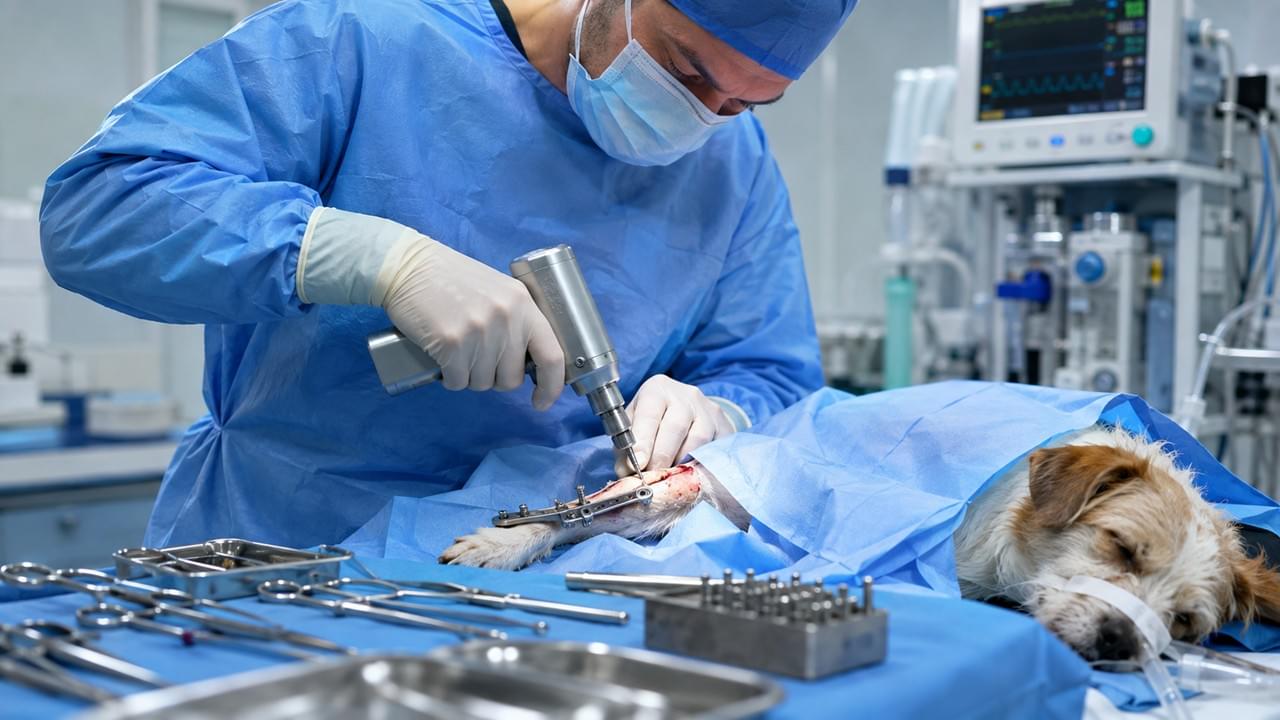
TL;DR: Veterinary orthopedic surgery has grown from a niche specialty into a mainstream service across companion animal practices. Whether you run a two-doctor clinic or a specialist referral hospital, the right power tools separate smooth procedures from prolonged surgeries. This guide covers the market trends behind the growth, how veterinary tools differ from human instruments, the power tools that anchor modern animal orthopedics, the four most common clinical applications, and a practical seven-item set every practice should consider — plus the procurement criteria worth checking before you buy.
📈 Why Veterinary Orthopedic Surgery Is Booming
This specialty has evolved from a niche offering into a mainstream clinical capability across companion animal practices worldwide. Several macro trends drive this growth:
- 🐾 Pet humanization — owners increasingly invest in advanced surgical interventions that were once considered cost-prohibitive; the global pet care market surpassed $260 billion in 2024
- 🏥 Specialist hospital expansion — specialty and emergency veterinary hospitals offering surgical services have multiplied across North America, Europe, and Asia-Pacific
- 🩺 Improved outcomes — advances in implant systems, power tool precision, and anesthetic protocols have pushed postoperative success rates sharply higher for procedures like cruciate ligament repair (TPLO) and femoral head ostectomy
- 🎓 Education alignment — veterinary surgical curricula now emphasize orthopedic technique, expanding the qualified practitioner base
Understanding the tools behind this surgical specialty matters for hospital administrators, surgical technicians, equipment distributors, and procurement specialists alike. The tools are where the science meets the operating table.
🧬 How Veterinary Tools Differ from Human Surgical Instruments
A common misconception is that veterinary tools are simply scaled-down human instruments. There is shared technology, yes, but the veterinary category stands apart in several practical ways.
| Dimension | Human Orthopedic Surgery | Animal (Veterinary) Surgery |
|---|---|---|
| Patient size range | Relatively standardized adult anatomy | Extreme range: 2 kg Chihuahua to 80 kg Great Dane to 500 kg horse |
| Bone density | Adult human cortical bone: ~1.5–2.0 g/cm³ | Varies widely; feline cortex thinner; equine bone exceptionally dense |
| Implant sizes | Standard orthopaedic sizing | Micro (veterinary mini) to large (equine) required |
| Regulatory framework | FDA 510(k), CE Medical Device | Veterinary device regulation, less stringent, varies by country |
| Sterilization | Hospital CSSD | Clinic-level autoclave, often in-house |
| Portability | Fixed hospital OR | Mobile field surgery capability often required |
| Handpiece ergonomics | Optimized for human hand grip | Different grip angles for veterinary surgical positions |
Can human tools be used on animals? Sometimes, yes — particularly in large-breed dogs and equine cases where bone dimensions approach human anatomy. But for cats and small-breed dogs, purpose-designed instruments with appropriately scaled attachments, handpiece dimensions, and speed control deliver better outcomes and longer equipment life. Purpose-built veterinary instruments simply make life easier on both counts.
🔧 Essential Veterinary Orthopedic Power Tools
Veterinary Bone Drills
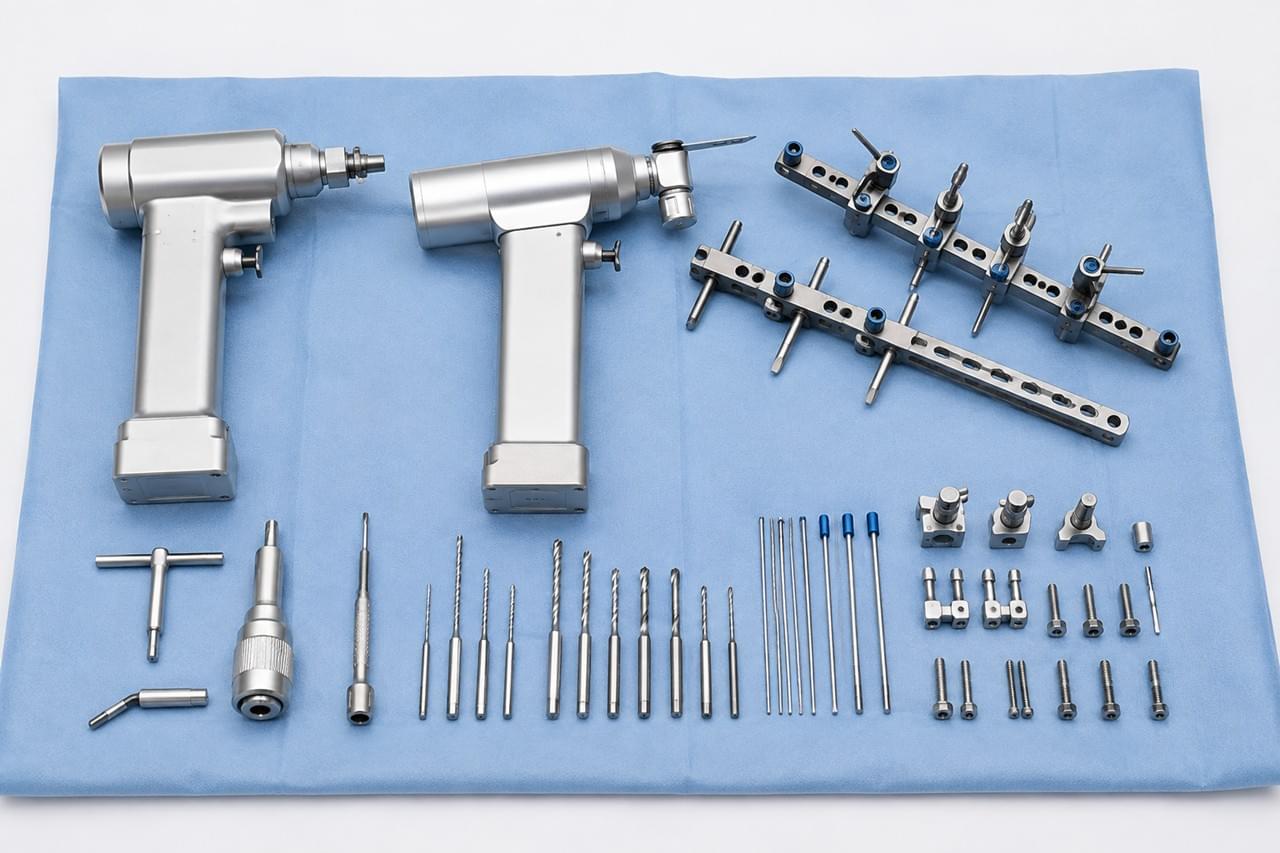
The veterinary bone drill is the cornerstone of orthopedic fixation procedures. What to look for:
- 🎯 Speed range — 0–1,500 RPM suits most small animal drilling; up to 35,000 RPM is needed for cortical penetration in large animals
- 🔩 Chuck systems — quick-release systems for rapid attachment exchange; compatibility with K-wires, drill bits, and cannulated systems
- ✋ Compact design — smaller handpieces for restricted surgical access in small animal procedures
- 🔋 Battery vs. pneumatic — portable battery-powered drills win in practices where central compressed air is unavailable
Best power source? Battery-powered cordless systems are the clear preference for most practices. They offer portability, freedom from compressed air constraints, and readiness for emergency and field surgery. Quality veterinary drills run on high-capacity lithium-ion batteries with fast charging and multi-unit charging docks.
Veterinary Oscillating Saws
Bone cutting — corrective osteotomy (TPLO, DPO/TPO), amputation, and joint replacement — demands oscillating saws with blades matched to animal anatomy:
- 🦴 TPLO saw blades, sized and curved for tibial plateau leveling osteotomy in dogs
- 🐱 Mini-oscillating saws for cats and small-breed dogs
- 🐴 High-torque large-animal systems for equine orthopedic surgery
External Fixators for Fracture Management
External fixation earns its place through minimally invasive application and adaptability across patient sizes. A well-designed veterinary external fixator system covers Type A linear configurations for simple diaphyseal fractures, articulating configurations for joint-spanning fixation, micro components for feline and small-dog cases, and full-size components for large breeds.
How do veterinary fixators differ from human ones? The biomechanical principles are the same — but scaling and configuration follow animal anatomy. Micro-sized components exist for feline and toy-breed fractures, and the clamp, pin, and bar systems are engineered for clinic settings with limited ancillary support, unlike hospital-based human systems.
📖 Related reading: Small Animal Fracture Repair: External Fixators for Mini and Micro Applications and External Fixator Solutions: Types and Clinical Recovery
Wire Drivers & Pin Systems
Kirschner wire insertion and intramedullary pinning remain fundamental techniques in small animal fracture management. Battery-powered wire drivers with precise speed control minimize thermal damage during pin insertion — a detail that shows up in patient recovery times.
🏥 Clinical Procedures: Common Applications
Fracture Repair in Small Animals: The Core of Veterinary Orthopedic Surgery
Long bone fractures — femur, tibia, radius, ulna — in dogs and cats are among the most common orthopedic emergencies in small animal practice. That makes fracture repair the everyday core of small animal orthopedic surgery. Treatment options:
- Intramedullary pinning — IM pins and cerclage wire for simple diaphyseal fractures
- Bone plating — TPLO plates and DCP plates applied with precision drilling and screw fixation
- External fixation — preferred for open and comminuted fractures, and cases requiring wound management access
TPLO: The Most Performed Veterinary Orthopedic Surgery in Dogs
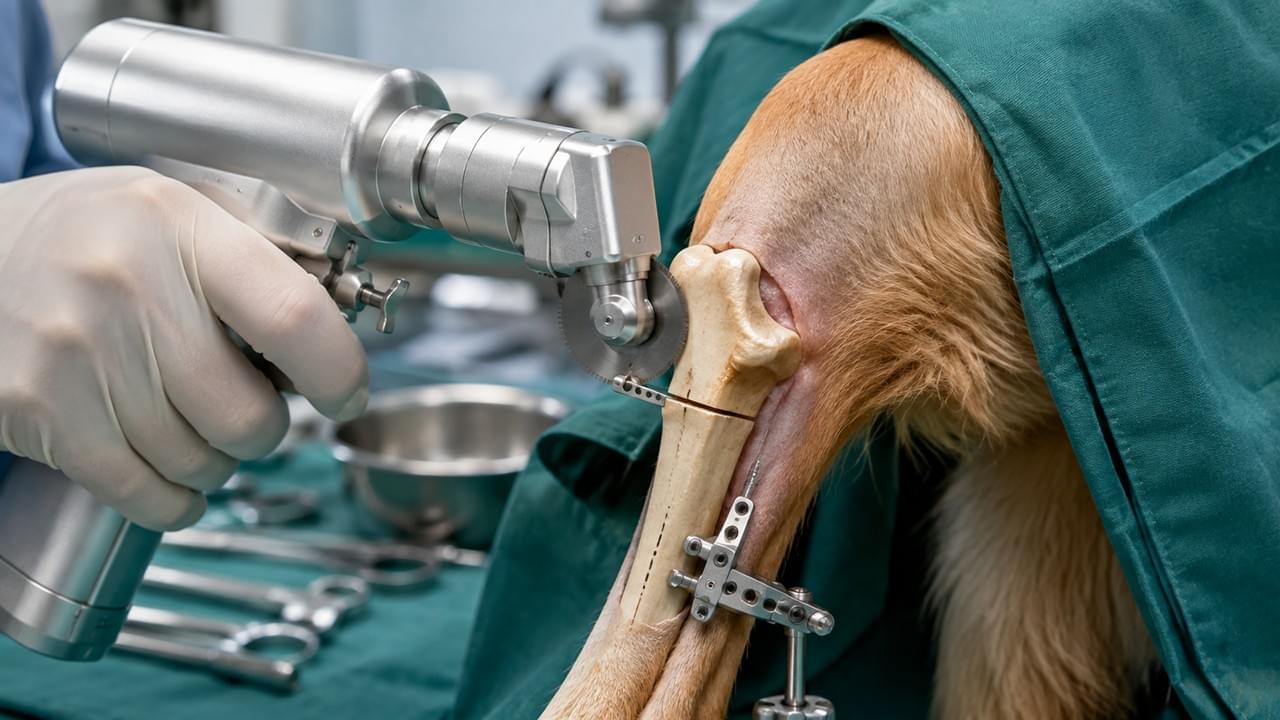
TPLO (tibial plateau leveling osteotomy) is the gold standard for cranial cruciate ligament rupture — the most common orthopedic condition in canine patients. The procedure:
- Curved osteotomy through the proximal tibia using a specialized circular saw
- Rotation of the tibial plateau to neutralize cranial tibial thrust force
- Stabilization with a dedicated TPLO plate and screws
It demands precision saw systems with controlled depth and radius of cut, plus reliable screw driving capability. If your clinic sees cruciate injuries — and most do — a TPLO-capable saw and drill combination belongs on the shortlist.
Total Hip Replacement: High-Stakes Veterinary Orthopedic Surgery
Canine total hip replacement is increasingly performed in specialist hospitals for hip dysplasia in large-breed dogs. It mirrors human total hip arthroplasty in complexity, requiring high-precision reamers for acetabular preparation, precision saws for femoral neck osteotomy, and controlled-torque screwdrivers for implant fixation.
Equine Cases: Veterinary Orthopedic Surgery at Its Most Demanding
Horses raise the difficulty bar. Fracture repair, arthroscopy, and limb salvage in equine patients demand high-torque, heavy-duty power systems adapted for the operating environment — equipment that has to be as reliable in the field as in the referral hospital.
🛒 Equipping Your Practice: Procurement Guidance
The 7-Item Veterinary Power Tool Set
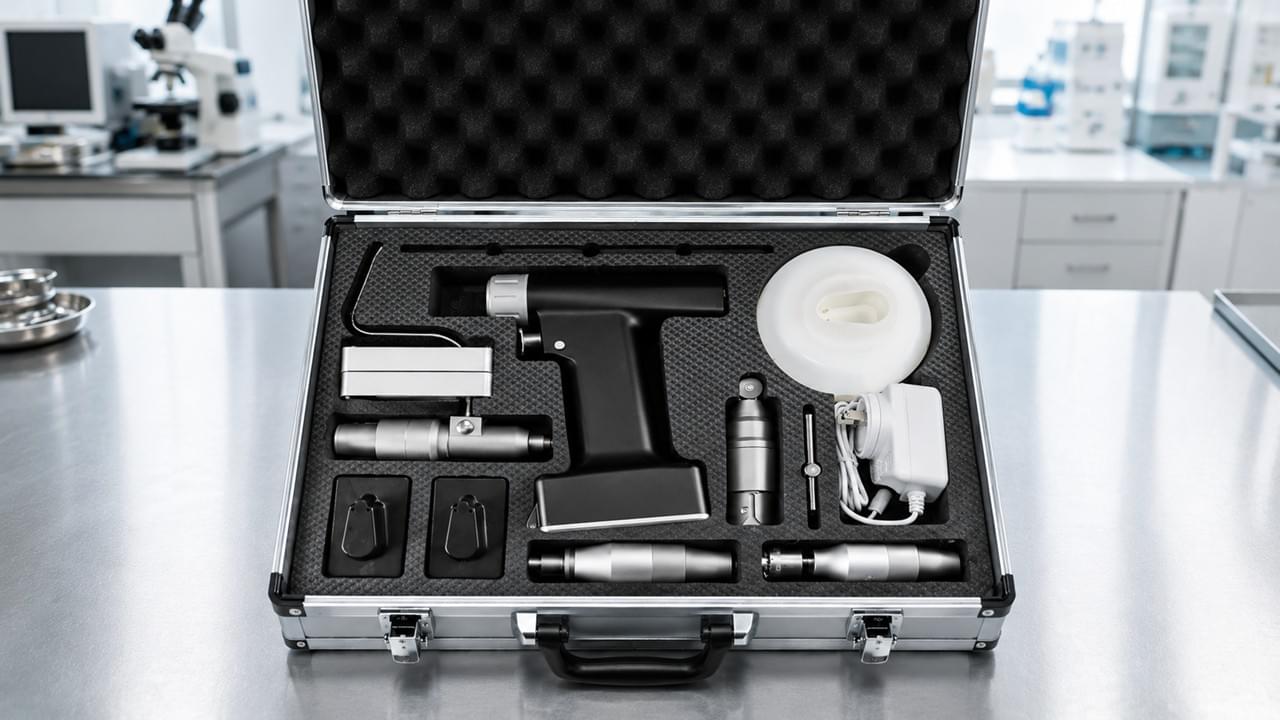
A complete veterinary orthopedic power tool set for a general surgical practice:
- 🔋 Battery-powered bone drill with K-wire chuck, Jacobs chuck, and cannulated drill adaptor
- 🪚 Battery-powered oscillating saw with standard and TPLO blade systems
- ⚡ Wire driver with multiple speed settings
- 🦴 External fixator system (mini + standard components)
- 🔌 Battery charger
- 🪫 Spare battery pack
- 🧰 Sterilization cases for all handpieces
📖 Related reading: How to Configure a Basic Orthopedic Instrument Set for Veterinary Clinics
Key Purchasing Criteria for Veterinary Surgical Equipment
When sourcing veterinary surgical equipment, evaluate suppliers on:
- GMP manufacturing standards — consistency matters even in veterinary product lines
- Product warranty — Vsun Medical provides a 2-year warranty on all veterinary orthopedic tools
- Small MOQ availability — practices often require modest initial quantities
- Technical support — user manuals, maintenance guides, and remote support
- Battery system compatibility — unified battery platforms reduce cost and inventory complexity
⚖️ Regulatory & Performance Considerations
Unlike human medical devices, veterinary surgical equipment generally avoids FDA 510(k) pre-market clearance. But reputable manufacturers apply GMP principles voluntarily — and premium veterinary tools meet the same autoclave standards (134°C, validated cycles) as human-grade instruments.
| Parameter | Human Surgical Tools | Veterinary Surgical Tools |
|---|---|---|
| Regulatory approval | FDA, CE Medical Device required | Veterinary-specific; varies by market |
| Autoclave compatibility | 134°C, validated cycles | Same standard for premium veterinary tools |
| Size range | Adult-optimized | Wide range for species diversity |
| Blade/attachment ecosystem | Human anatomy–standardized | Species-specific variants available |
| Price point | Premium (regulatory cost embedded) | Generally 20–40% lower than human equivalents |
The result: comparable clinical performance at a meaningfully lower price point, which is why specialist veterinary lines have become the pragmatic choice for growing practices. For deeper comparisons, see Veterinary vs. Human Surgical Power Tools: Performance Differences and Regulatory Considerations, and cross-check technique guidance against AAOS orthopaedic surgical technique references.
🚀 Expert Advisory: What’s Next in Veterinary Orthopedics
Vsun Medical Veterinary Product Development Insights:
- Miniaturization continues — demand for feline-specific and toy-breed instruments is accelerating as exotic companion animal surgery goes mainstream
- Portable battery systems — self-contained battery-powered systems eliminate compressed air dependency, enabling field surgery, mobile veterinary units, and low-resource clinic settings
- Cross-species platforms — single platforms with species-specific attachment libraries reduce procurement complexity for multi-species practices
The trend lines point one direction: smaller, smarter, more portable tools that let more clinics deliver specialist-level care. The Veterinary Orthopedic Society clinical resources are a useful benchmark for staying current on technique and equipment expectations.
✅ Equip Your Practice with Professional-Grade Orthopedic Tools
Vsun Medical manufactures a complete range of veterinary surgical equipment — compact bone drills, oscillating saw systems, wire drivers, and external fixator kits — under GMP-compliant production standards with a 2-year product warranty. The line covers the full spectrum of companion and large animal orthopedic procedures, with flexible MOQ options for practices of every size.
Contact our veterinary equipment specialists today for:
- Product catalogs and technical specifications
- Sample units for clinical evaluation
- Custom configuration recommendations for your caseload
- Global shipping and export documentation
📋 Request Veterinary Equipment Catalog → vsunmedical.com/contact
Or explore the full veterinary orthopedic tools product range.
GMP Compliant · ISO Certified · 2-Year Warranty · Veterinary Specialist Support
 English
 Arabic
 German
 French
 Italian
 Spanish
 Russian
 Japanese
 Korean
 Turkish
 Portuguese