
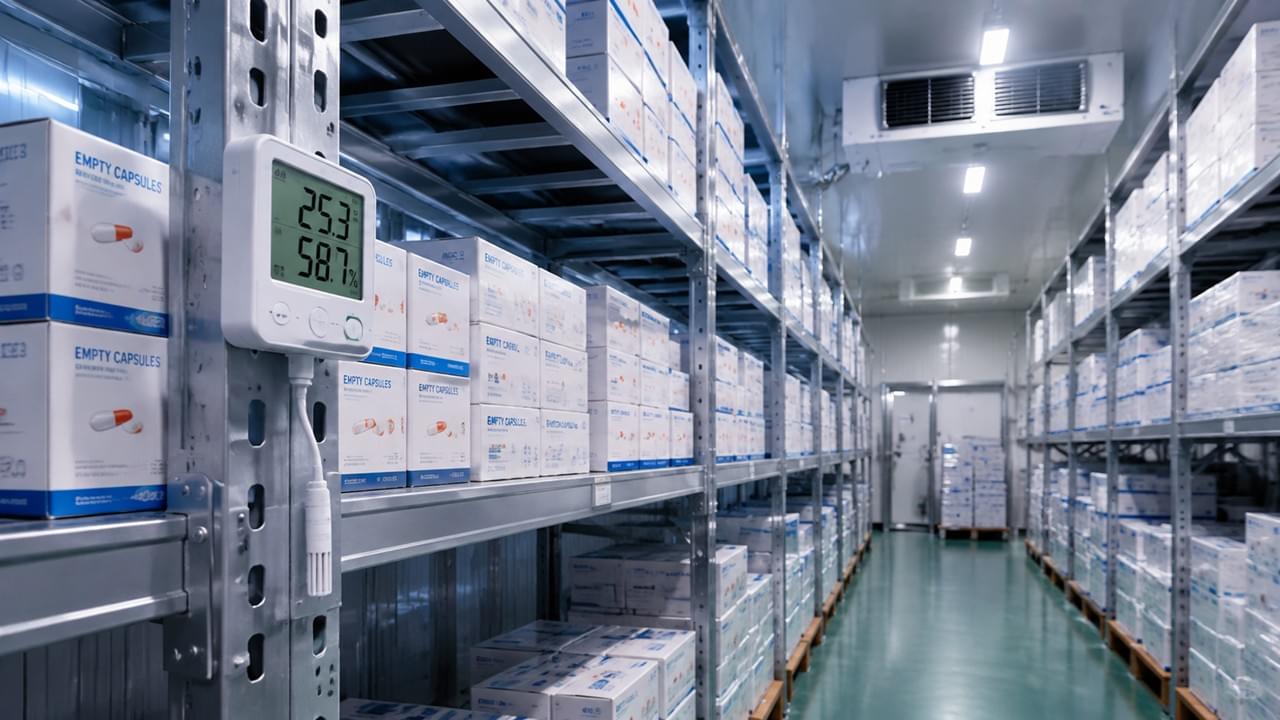
📘 This article is part of our comprehensive guide: Pharmaceutical Empty Capsules: The Complete Selection Guide
TL;DR: Empty capsules look tough, but they are hygroscopic — they quietly absorb and release moisture with every shift in ambient humidity. Get your capsule storage conditions wrong, and you’ll pay for it at the filling line: brittle shells, sticky batches, deformed capsules, even dissolution failures. This guide explains the science behind storage-related degradation, the optimal conditions for gelatin, HPMC, pullulan, and enteric capsules, seven warehouse rules that protect your stock, and exactly when to test for stability.
🌡️ Why Capsule Storage Conditions Matter: The Science
Hard pharmaceutical capsule shells — whether gelatin, HPMC, or pullulan — are hygroscopic materials. Their physical properties hang directly on moisture content, which continuously equilibrates with the relative humidity (RH) of the surrounding environment. That one simple fact drives everything else in this article.
Moisture content affects:
- 🥚 Shell flexibility and brittleness — optimal moisture keeps the shell pliable; too dry means brittle fractures, too wet means soft deformation
- 📏 Capsule dimensions — shells absorb moisture and swell slightly; excess moisture causes sealing problems, while low moisture causes shrinkage and potential fill leakage
- 💊 Dissolution behavior — altered moisture content shifts dissolution kinetics, impacting drug release and bioavailability
- ⚙️ Filling machine compatibility — out-of-spec moisture triggers filling line performance issues (see our Capsule Filling Machine Compatibility Guide)
- ⏳ Shelf life — improper storage accelerates every degradation mechanism listed above
📦 Optimal Storage Conditions by Capsule Type
Capsule Storage Conditions for Gelatin Capsules
Gelatin capsules are the most moisture-sensitive of the group, thanks to their high equilibrium moisture content of 13 to 16%. Get these capsule storage conditions wrong, and gelatin capsule humidity damage appears fast — sticky, soft shells that refuse to run on the line.
| Condition | Effect on Gelatin Capsule |
|---|---|
| ✅ Ideal: 15–25°C, 35–65% RH | Maintains 13–16% moisture; optimal physical properties |
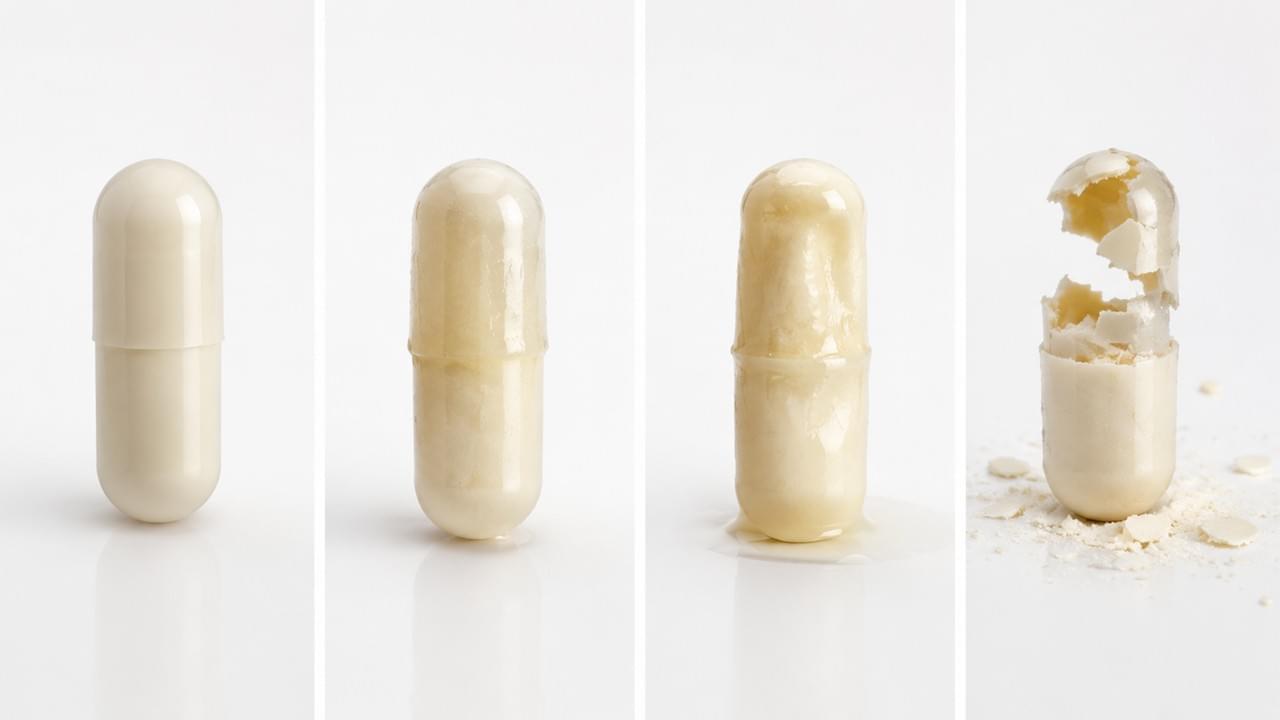
| 🚨 >75% RH | Absorbs excess moisture → soft, sticky, deformed; bodies may fuse |
| 🚨 <25% RH | Dries out → brittle; prone to splitting and cracking on filling lines |
| 🚨 >35°C | Accelerates gelatin cross-linking; slower dissolution; possible sticking in bulk |
| ⚠️ Temperature cycling | Condensation risk; promotes surface moisture and microbial growth |
| ⚠️ UV light exposure | Color changes in dyed gelatin; reduced transparency in clear shells |
Recommended storage: 15–25°C, 40–60% RH, in sealed original packaging, away from direct light.
Capsule Storage Conditions for HPMC Vegetable Capsules
HPMC capsules carry a much lower equilibrium moisture content — just 4 to 6% — and tolerate humidity extremes far better than gelatin.
| Condition | Effect on HPMC Capsule |
|---|---|
| ✅ Ideal: 15–25°C, 35–65% RH | Maintains 4–6% moisture; optimal dimensional and mechanical properties |
| 🚨 >75% RH | Dimensional swelling; paradoxical brittleness at high humidity; surface tackiness |
| 🚨 <20% RH | Brittle shell; higher breakage on filling lines; electrostatic charge buildup |
| ⚠️ >40°C | Minimal thermal risk; prolonged exposure may still affect dissolution |
Key advantage: HPMC capsules tolerate a wider humidity range, making them a smarter fit for tropical climate distribution chains. If plant-based demand matters in your market, our guide on HPMC Vegetable Capsules for the Vegan Market is well worth a read.
Capsule Storage Conditions for Pullulan & Enteric Capsules
Pullulan capsules share most of HPMC’s storage profile but add an oxygen-sensitivity twist: prolonged oxygen exposure degrades the oxygen-barrier polymer layer and reduces functional performance. Store them in nitrogen-purged sealed packaging until ready for use, and minimize ambient air exposure during dispensing.
Enteric-coated capsules demand the strictest handling of all. The polymer coating brings its own failure modes — plasticization above 65% RH, tackiness above 30°C, and microcracks from repeated humidity cycling.
| Capsule Type | ✅ Ideal Range | ⚠️ Critical Watch-Out |
|---|---|---|
| Pullulan | 15–25°C, 35–60% RH | Oxygen exposure degrades barrier layer |
| Enteric | 15–25°C, 35–60% RH | Coating tackiness, plasticization, microcracks |
⚠️ The Humidity–Temperature Trap
Temperature Cycling + Humidity: The Worst Capsule Storage Conditions
The single most damaging scenario in this entire guide is temperature cycling combined with high humidity. When temperature drops below the dew point, condensation forms directly on capsule surfaces — a concentrated moisture insult that accelerates every humidity-driven degradation mechanism at once.
Real-world scenario: capsules shipped by sea container from a cold-climate country through a tropical port at 35°C and 90% RH experience brutal temperature cycling unless the container is insulated. Without moisture-barrier packaging and a desiccant system, significant capsule damage happens during transit.
Mitigation checklist:
- 📦 Request capsules packed with silica gel desiccant sachets inside moisture-barrier packaging
- 🚢 Specify temperature-controlled (reefer) container shipping for large-volume imports
- 🔬 Add post-transit capsule stability testing to your incoming QC procedure
Can capsules recover? Gelatin capsules sometimes bounce back from moderate humidity exposure after re-equilibrating at standard conditions — 20 to 25°C at 50% RH for 24 to 48 hours. But severely over-humidified capsules that have deformed, fused together, or grown microbial contamination cannot be saved; discard them. HPMC capsules are more forgiving and generally recover well from moderate excursions.
🏭 7 Warehouse Rules That Keep Capsule Storage Stable
Storage Facility Requirements
Solid pharmaceutical capsule warehouse storage starts with the facility itself. Here are the seven requirements every compliant storage area should meet.
| # | Requirement | Standard |
|---|---|---|
| 1 | Temperature | 15–25°C, continuously monitored |
| 2 | Relative humidity | 40–60% RH, continuously monitored |
| 3 | Monitoring | Calibrated data loggers; alarms for out-of-range events |
| 4 | Air handling | HVAC with dehumidification capability |
| 5 | Light | No direct sunlight; UV-filtered fluorescent or LED |
| 6 | Pest control | Active program; sealed storage area |
| 7 | Floor clearance | Pallets ≥15 cm off the floor for air circulation |
FIFO Inventory Protocol
Pharmaceutical capsule inventory must follow FIFO — First In, First Out — so the oldest stock is always used first and expired capsules never sneak into production. Label every incoming lot with receipt and expiry dates, and physically place new stock behind existing stock. For a broader view of what compliant manufacturing looks like, see Quality Standards in Medical Manufacturing.
Dispensing & Usage
- Open capsule packaging only inside the filling room, where temperature and humidity are controlled
- Pre-condition opened packaging in the filling room for 12–24 hours before filling
- Reseal partially used boxes with moisture-barrier tape between shifts
- Never leave partially opened boxes in ambient warehouse conditions
🔬 Stability Monitoring: When to Test
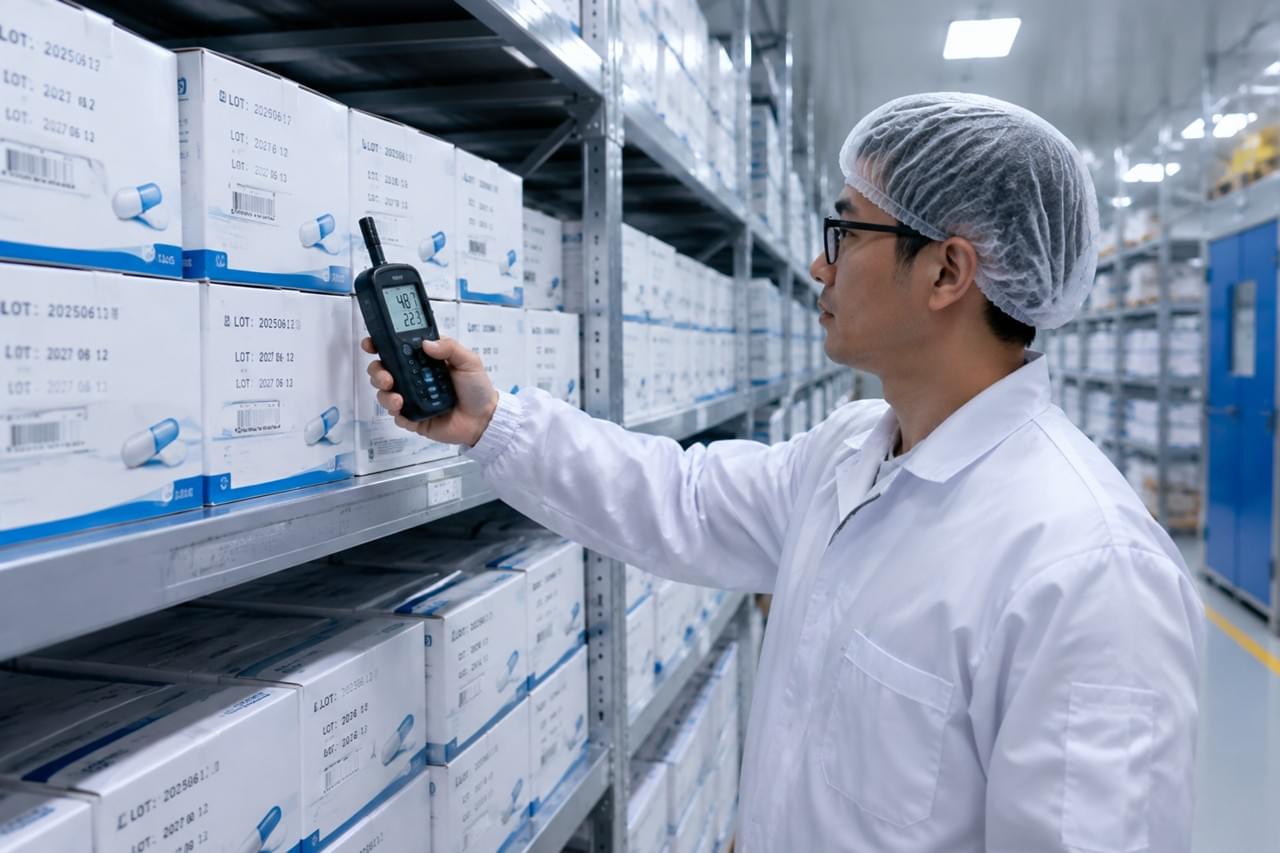
Routine Incoming QC (Per Lot)
- 💧 Moisture content (loss on drying or Karl Fischer method)
- ⏱️ Disintegration time (per USP/EP method)
- 📐 Dimensions (caliper measurement vs. specification)
- 👁️ Visual inspection (color, appearance, surface defects)
Event-Triggered & Annual Testing
- Post-transit stability assessment after long sea transport
- Annual stability testing of opened lots stored for more than 6 months
- Testing after any documented storage excursion — humidity or temperature alarm events
Moisture out of specification? Follow this path: quarantine the lot, investigate shipment and storage history, run expanded testing (disintegration, dimensions), and attempt controlled re-equilibration at standard conditions if the deviation is correctable — your capsule manufacturer can advise. Then issue a deviation report and CAPA for root-cause investigation. When designing your stability program, align it with ICH Q1A stability testing guidelines for pharmaceuticals.
🌏 Expert Advisory: Capsule Storage in Tropical Markets
Vsun Medical Quality Management Team:
“In markets with tropical climates and less developed cold-chain infrastructure — Southeast Asia, sub-Saharan Africa, parts of South America — capsule storage conditions are a significant supply chain challenge. Our recommendation for distributors: (1) specify moisture-barrier primary packaging with 2 g silica gel desiccant per box; (2) require temperature and humidity monitoring certificates for every shipment; (3) provide storage-area cooling with humidity control at the distributor level; (4) conduct incoming moisture content testing on arrival before releasing to customer inventory.”
What about shelf life? Properly stored, empty capsule shelf life typically runs 24 to 36 months from manufacture — for gelatin, HPMC, or pullulan — when kept at 15–25°C and 40–60% RH in sealed original packaging. Check the expiry date on each lot’s Certificate of Analysis, and always run incoming QC if capsules arrive close to expiry.
Best packaging for long hauls? For extended sea freight, layer your protection: multi-layer foil laminate bags (PVDC/Al/PE construction) sealed with desiccant sachets — silica gel or molecular sieve — inside moisture-barrier cardboard cartons. That combination holds up across weeks of transit, and Vsun Medical can supply capsules in enhanced moisture-barrier packaging on request. The WHO guidelines for medicines storage provide a solid reference framework for distributor-level warehousing practices.
✅ Source Capsules with Verified Stability
Vsun Medical supplies pharmaceutical empty capsules with complete stability data, moisture content CoA for every batch, and optional enhanced moisture-barrier packaging built for tropical markets and long-distance supply chains. If your filling line depends on shell consistency, your storage plan deserves documentation you can trust.
📋 Request Capsule Stability Documentation → vsunmedical.com/contact
Or explore the full pharmaceutical empty capsules product range to match the right shell to your market and formulation.
GMP Compliant · ISO Certified · Full Batch Stability Documentation · Global Supply
 English
 Arabic
 German
 French
 Italian
 Spanish
 Russian
 Japanese
 Korean
 Turkish
 Portuguese