
Part of our guide: Quality Standards in Medical Manufacturing: GMP, ISO, and the Path to Reliable Supply
TL;DR: An orthopedic equipment warranty is the cheapest quality audit you will ever run. The length, coverage, and response terms a manufacturer commits to reveal how confident they are in their materials, processes, and quality system — long before you dissect a single drill. This guide explains what a real 2-year warranty should cover, the 7 checks to run before you sign a purchase order, and the test data that stands behind ours.
🎯 What a Warranty Really Signals About Manufacturing Quality
In medical device procurement, price is visible immediately. Quality is invisible until something fails in the middle of a surgical schedule.
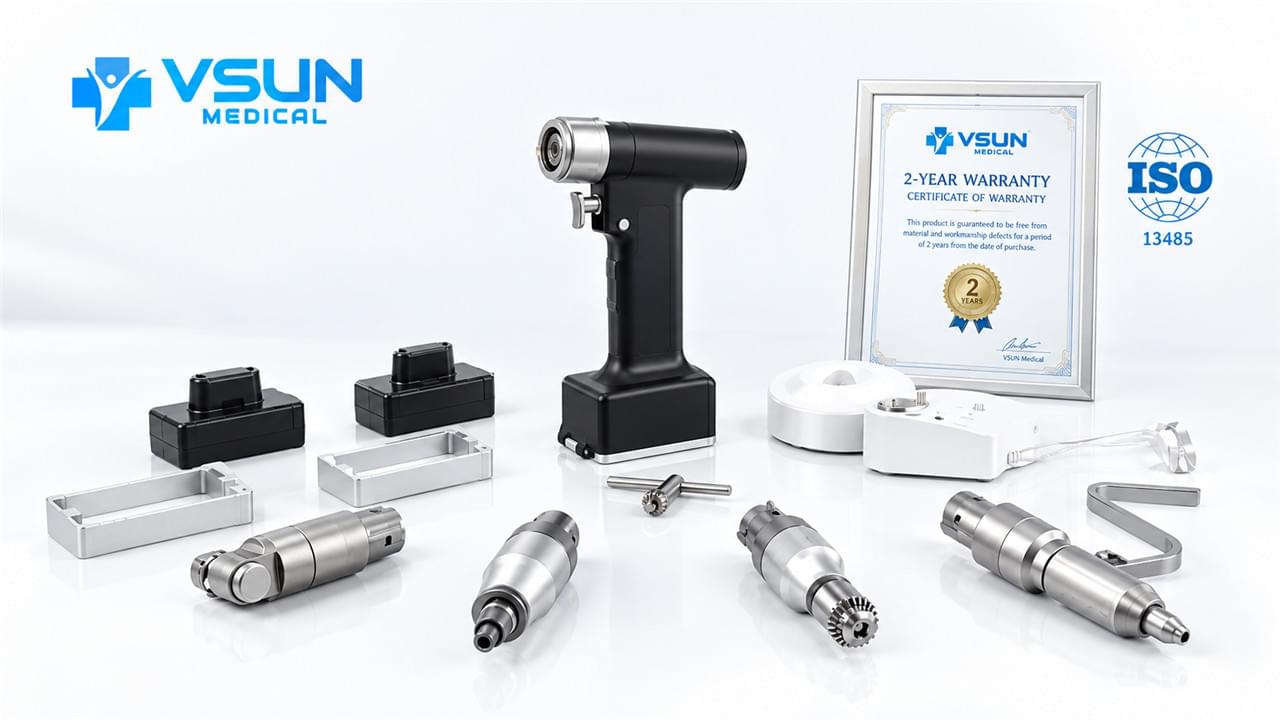
A warranty bridges that gap. When a manufacturer puts a 2-year warranty on orthopedic surgical instruments, they’re making a concrete financial promise: if it fails under normal use within two years, they repair or replace it at their cost.
That promise only makes economic sense if the manufacturer is confident about three things:
- 🧬 Material durability — the alloys, coatings, and components will survive at least 2 years of clinical use
- 🏭 Production consistency — processes are controlled tightly enough that virtually every unit meets specification
- 📊 Failure rate prediction — in-house reliability testing shows claims won’t be commercially damaging
A supplier offering 6 months on surgical instruments is telling you something too: either they doubt their product’s longevity, or they never invested in the accelerated life testing and process validation needed to stand behind longer coverage.
🔬 Reading the Fine Print: What Coverage Should Include
When you compare medical device warranty terms across suppliers, the real differences hide in the wording — not the headline number.
What a 2-Year Orthopedic Equipment Warranty Should Cover
Look for explicit coverage of these failure categories:
| Failure Category | Covered Under Quality Warranty? |
|---|---|
| Chuck mechanism failure (bearing wear, jaws fail to grip) | ✅ Yes — manufacturing defect |
| Motor failure under normal use | ✅ Yes — component quality |
| Battery premature capacity loss (<80% at 100 cycles) | ✅ Yes — cell quality |
| Surface corrosion from normal autoclave sterilization | ✅ Yes — material/coating quality |
| Blade/attachment breakage under normal use | ✅ Yes — material fatigue |
| Damage from misuse or dropped instruments | ❌ No — user responsibility |
| Consumable wear items (drill bits, saw blades per rated life) | ❌ No — consumables excluded |
The covered rows are where the manufacturer puts money behind materials and workmanship. The exclusions are normal and fair — a warranty that claims to “cover everything” usually covers nothing precisely.
Response Terms That Separate Strong from Weak
Duration gets the attention; response terms decide whether a warranty is actually usable:
- ⏱️ Response commitment — repair or replacement initiated within 10–15 business days
- 📦 Ship-before-return option — for critical instruments, the replacement leaves before the defective unit arrives
- 🚚 No-cost shipping — the manufacturer covers freight on warranty claims
- 🛠️ Engineering access — failure analysis and technical guidance, not just a silent swap

🔍 7 Checks Before You Sign the Purchase Order
Use this framework when comparing competing suppliers side by side:
Comparing Orthopedic Equipment Warranty Terms: The 7-Point Framework
| # | Criterion | Strong Warranty | Weak Warranty |
|---|---|---|---|
| 1 | Duration | 24 months minimum | 6–12 months |
| 2 | Coverage scope | Manufacturing defects clearly defined | Vague exclusions, limited scope |
| 3 | Sterilization cycles | Specific validated count (e.g., “300+ autoclave cycles”) | No cycle count specified |
| 4 | Response mechanism | Clear RMA process, committed turnaround | No defined process |
| 5 | Replacement vs. repair | Both available; surgeon notified | Repair only, long turnaround |
| 6 | Documentation | Written certificate per unit | Verbal only, buried in T&Cs |
| 7 | ISO backing | ISO 13485-certified QMS behind the warranty (see the standard) | No quality system certification |
Is two years even standard? For Chinese-manufactured orthopedic instruments, often not — 12 months or less is common. Premium Western brands offer 2 years more frequently but attach restrictive conditions: sterilization cycle limits, authorized-service-only clauses. Judge the actual surgical instrument warranty terms in writing, not the number printed on the certificate.
The One Question That Exposes a Weak Warranty
Ask the supplier: “How many warranty claims did you process last year, and what was the most common failure mode?”
A manufacturer confident in their quality answers openly, with numbers. Evasiveness here is the single most reliable red flag in medical device sourcing — our global sourcing guide lists it alongside certificate checks in the standard due-diligence sequence.
💰 Warranty vs. Total Cost of Ownership: The Math Buyers Miss
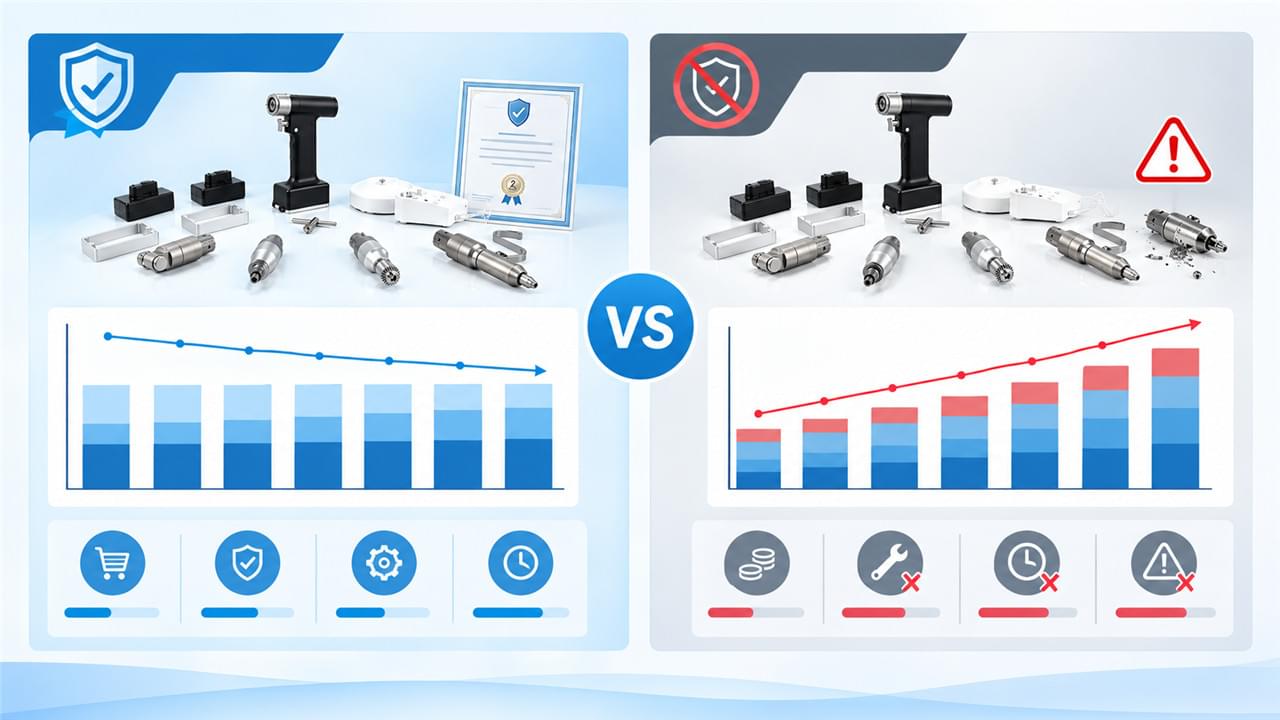
A lower purchase price without adequate coverage can cost more over two years than the premium option:
Scenario A — GMP supplier, 2-year warranty
- Purchase price: $2,000/drill
- Warranty claim rate: <2%
- Expected 2-year ownership cost: ~$2,040
Scenario B — low-price supplier, 6-month warranty
- Purchase price: $1,200/drill
- Failure rate: 15% within 18 months
- Post-warranty replacement: ~$180 expected
- Downtime and surgical schedule disruption: ~$500
- Expected 2-year ownership cost: ~$1,880 — with considerably more risk attached
The gap looks narrow until you add what doesn’t fit in a spreadsheet cell: rescheduled surgeries, procurement hours spent chasing failures, and the reputational cost when an instrument dies mid-procedure.
Why an Orthopedic Equipment Warranty Pays for Itself
Factor in everything above and the premium supplier with a genuine 2-year commitment consistently delivers better total value. The warranty isn’t a price premium — it’s insurance you’re already paying for inside the supplier’s quality system. A serious orthopedic tool quality guarantee simply moves that insurance from the fine print to the front of the contract.
🧪 What Backs Our 2-Year Promise: Four Layers of Evidence
Ours is not a marketing line without engineering behind it. Four layers of evidence:
Material Qualification Testing
- Surgical-grade 316L stainless steel per ASTM F138, with material test certificates for every lot
- Grade 5 titanium per ASTM F136
- Surface treatments validated for corrosion resistance per ASTM F2129 electrochemical testing
Sterilization Cycle Validation
- Accelerated testing across 500 consecutive autoclave cycles at 134°C, 18 minutes
- Dimensional, surface, and functional assessment at 100, 300, and 500 cycle intervals
- No significant degradation observed within rated cycle life
If you want to see where this testing happens, we documented the production floor itself in our GMP manufacturing facility walkthrough.
Accelerated Life Testing
- Motors and mechanical assemblies run at 200% rated operating hours under elevated temperature and cycling load
- Battery systems pushed through 600 charge-discharge cycles to confirm >80% capacity retention
This is also where handpiece and battery coverage under the warranty gets defined: capacity degradation beyond the tested lifecycle within the warranty period is covered; normal wear past the cycle specification is consumable.
Field Failure Tracking
- Systematic claim tracking and root cause analysis
- CAPA process for any emerging failure trend
- Continuous product improvement from field data
Regulators expect the same loop — the FDA quality system regulation treats postmarket performance data as evidence of real production control. Test, ship, track, improve: it’s the same philosophy behind our orthopedic power tools complete guide and every instrument in the catalog.
The Orthopedic Equipment Warranty, Documented End to End
Put the four layers together and the logic closes: qualified materials feed validated processes, validated processes feed predictable failure rates, and predictable failure rates make a 2-year commitment safe to offer — and safe to accept. That’s why every Vsun Medical shipment includes a written warranty certificate tied to the serial number, so the coverage you hold in your hand traces back to the same records an auditor would review.
📬 Choose a Supplier That Stands Behind Its Products for 2 Full Years
Our quality team’s position is simple: when buyers ask about the warranty, we treat it as an invitation to show test data — not a negotiation point to walk back. Every shipment carries a written warranty certificate, our RMA process runs on a 15-business-day turnaround commitment, and every claim feeds product improvement.
If a supplier can’t explain what evidence supports their warranty duration, that’s the moment to ask harder questions. Or just start with one who already published it.
Request Warranty Terms & Product Specifications → vsunmedical.com/contact
GMP Compliant · ISO Certified · 2-Year Warranty · Documented Quality Evidence
 English
 Arabic
 German
 French
 Italian
 Spanish
 Russian
 Japanese
 Korean
 Turkish
 Portuguese