
Part of our guide: Quality Standards in Medical Manufacturing: GMP, ISO, and the Path to Reliable Supply
TL;DR: Pharmaceutical grade gelatin is the starting point of every hard capsule on the market — and its quality, safety, and consistency decide the performance of every capsule made from it. This guide covers what “pharmaceutical grade” actually requires, Type A vs. Type B sourcing, BSE/TSE safety, pharmacopoeial testing, and the 7 checks every capsule buyer should run before signing a purchase order.
🎯 Why the Starting Gelatin Decides Capsule Performance
Capsule shells look simple, but they inherit every weakness of the material they came from. A gelatin batch with drifting viscosity produces shells with inconsistent wall thickness. A batch with unclear origin documentation can stall an entire regulatory submission. Poor microbiological quality shows up later as failed bioburden testing on finished capsules.
That’s why serious capsule manufacturers treat gelatin qualification as the most consequential incoming inspection they run. Below is what that qualification actually involves — and what you, the buyer, should demand to see.
🧬 What Makes Gelatin “Pharmaceutical Grade”?
What Is Pharmaceutical Grade Gelatin?
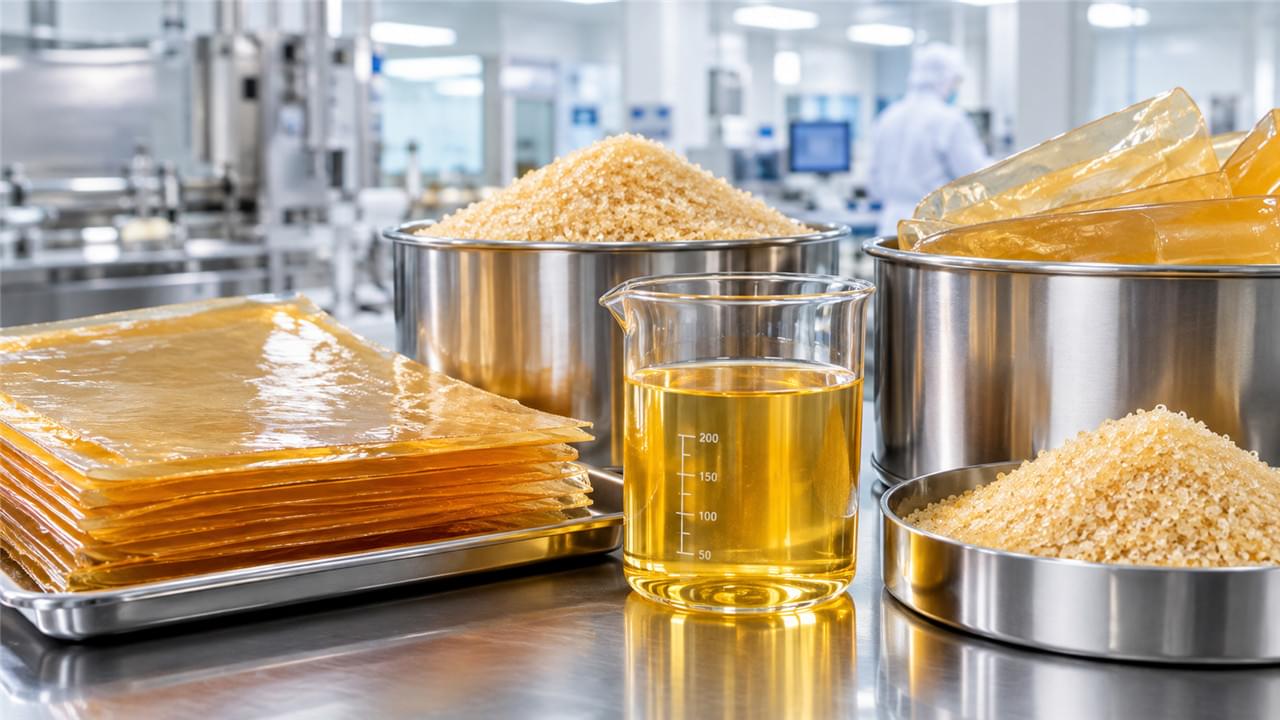
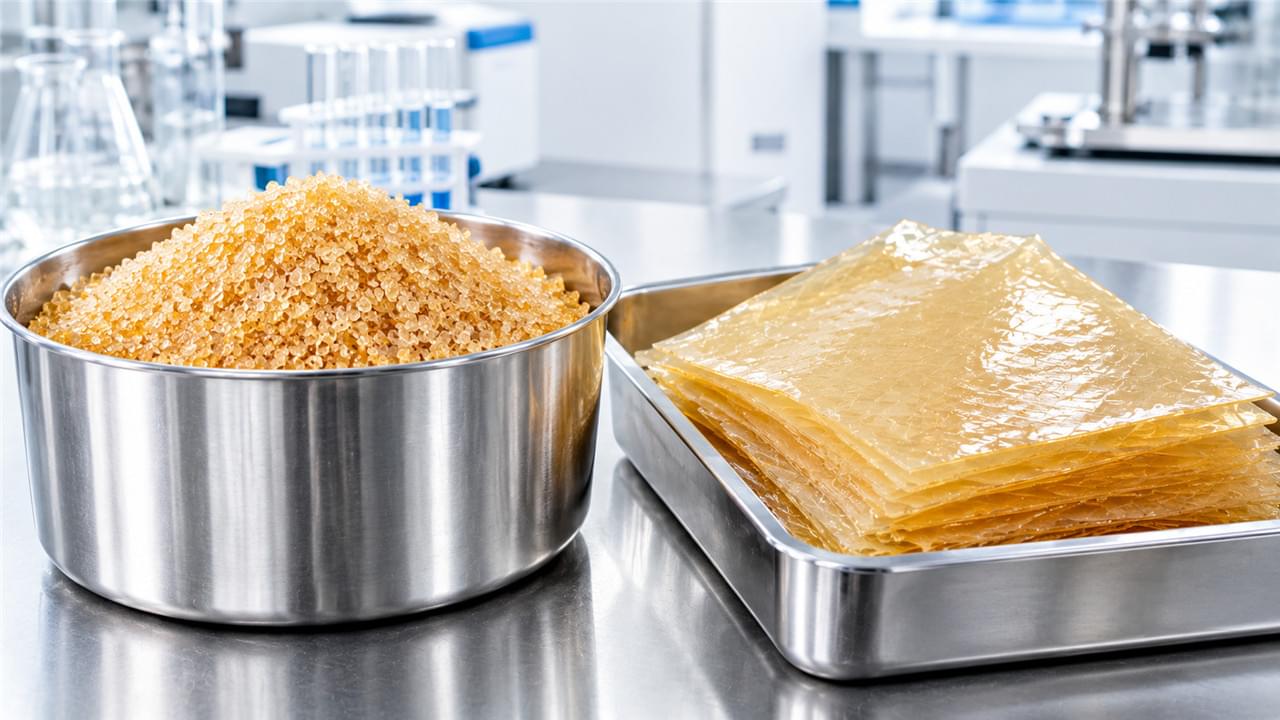
Definition: gelatin is a protein product from the partial hydrolysis of collagen — the primary structural protein in animal connective tissue (skin, bone, tendons). In pharma applications it forms hard capsule shells, softgel membranes, tablet coatings, and drug delivery matrices.
What separates pharmaceutical grade from food-grade or technical-grade material:
- 🔬 Purity limits per pharmacopoeial monographs (USP, EP)
- 🐄 Validated sourcing from BSE/TSE-compliant animal origins
- 📜 Full batch traceability from slaughterhouse to finished gelatin lot
- 🦠 Defined microbiological limits
- 📏 Consistent molecular weight and viscosity specifications
Type A vs. Type B: Bovine and Porcine Gelatin
Both bovine and porcine gelatin are used commercially, and the difference comes down to processing chemistry:
| Property | Type A (Acid Process) | Type B (Alkaline Process) |
|---|---|---|
| Source | Porcine skin | Bovine hide or bone |
| Pre-treatment | Acid, then hot water extraction | Lime (alkaline), then hot water extraction |
| Isoelectric point (pI) | 7.0–9.0 | 4.7–5.4 |
| Bloom strength | 150–300 Bloom | 50–300 Bloom |
| Viscosity at equal Bloom | Lower | Higher |
| Certification fit | Standard markets | Preferred for halal/kosher capsules |
One practical note: Type A, being porcine-derived, is not inherently halal or kosher. Halal and kosher certified capsules use bovine or fish gelatin with appropriate certification — which makes the documentation trail in the next section even more important.
🛡️ BSE/TSE Safety: The Non-Negotiable Requirement
Definition — BSE: bovine spongiform encephalopathy, a transmissible spongiform encephalopathy (TSE) in cattle — “mad cow disease” — transmissible to humans as variant Creutzfeldt-Jakob Disease (vCJD).
For bovine gelatin, BSE/TSE risk management is a regulatory requirement enforced worldwide:
| Regulatory Body | Guideline | Key Requirement |
|---|---|---|
| WHO/FAO/OIE | BSE risk assessment guidelines | Source animals from BSE-free or BSE-controlled countries |
| EMA (Europe) | EMEA/410/01 rev.3 | Country risk categorization; exclusion of specified risk material |
| FDA (US) | 21 CFR 189.5 | BSE risk assessment for gelatin sourcing; country restrictions |
| ICH Q5A | Viral safety evaluation | Removal/inactivation validation for TSE agent |
BSE Risk Management for Pharmaceutical Grade Gelatin
Four sourcing criteria define compliant bovine gelatin:
- 🌍 Geographical restriction — cattle from countries classified BSE negligible or controlled risk by the OIE
- 🚫 Specified Risk Material (SRM) exclusion — brain, spinal cord, dorsal root ganglia, eyes, tonsils, and intestine (duodenum to rectum) never enter the production chain
- 🐂 Age restriction — cattle below 30 months (36 depending on country classification)
- 🔗 Traceability — a documentary trail from slaughterhouse through hide processing to the gelatin batch
And the chemistry helps: the extraction process itself — alkaline treatment at pH >12 for Type B, acid treatment at pH <4 for Type A — denatures proteins and adds a further layer of TSE risk reduction recognized by WHO, EMA, and FDA guidance.
Practical implication: a capsule manufacturer using bovine gelatin must be able to produce the BSE risk assessment documentation on request. Ours is maintained for every bovine gelatin source, aligned with WHO BSE/TSE guidelines.
🧪 Pharmacopoeial Testing: What Defines the Grade
How Pharmaceutical Grade Gelatin Is Tested
Every batch must clear the full pharmacopoeial monograph — see the USP gelatin standards for the authoritative text:
| Test | Method | Specification |
|---|---|---|
| Identity (gelatin test) | Chemical precipitation | Positive |
| Gel strength (Bloom) | Bloom gelometer | Typically 200–250 Bloom for capsules |
| Viscosity | Ostwald viscometer | Per specification |
| pH | pH meter | 3.8–5.5 (Type B); varies for Type A |
| Loss on drying | Gravimetric | ≤15% |
| Ash (residue on ignition) | Gravimetric | ≤2.0% |
| Heavy metals | Atomic absorption | ≤20 ppm |
| Arsenic | Colorimetric | ≤1 ppm |
| Chromium | AAS / ICP-MS | ≤10 ppm |
| Sulfur dioxide | Titration | ≤50 ppm |
| Peroxide | Colorimetric | ≤10 ppm |
| Microbial (TAMC/TYMC) | Plate count | TAMC ≤1000 CFU/g; TYMC ≤100 CFU/g |
| Pathogen absence | Selective media | Absent in 10 g sample |
| Water-soluble substances | Gravimetric | Per specification |
The European Pharmacopoeia adds solution transparency and color, isomer content (α, β, γ chain composition), and conductivity.
A note on Bloom strength — the measure of gel firmness buyers ask about most: capsule gelatin typically runs 200–300 Bloom. Higher Bloom gives harder, more rigid shells with slower dissolution; lower Bloom gives softer, more flexible shells. The grade is chosen against capsule size, fill compatibility, and dissolution targets.

📋 Qualification in Practice: From Supplier Audit to Retention Sample
Inside Our Gelatin Raw Material Specification & Qualification Process
Gelatin capsule material sourcing is only as strong as the process behind it. Ours runs six steps:
- 🗂️ Supplier pre-qualification — an Approved Supplier List (ASL); new suppliers enter through on-site audit and documentation review
- 🔬 Incoming inspection — every gelatin batch is tested against the full pharmacopoeial specification on receipt
- 🛡️ BSE/TSE verification — country-of-origin certificates, SRM exclusion, and age restriction compliance checked per batch
- 🔗 Batch traceability — unique lot number assigned, traceable from slaughterhouse origin to capsule production batch
- 📄 CoA cross-verification — the gelatin maker’s Certificate of Analysis is checked against our own test results; discrepancies trigger quarantine and investigation
- 🧊 Retention samples — kept for a minimum of 5 years for retrospective analysis
And when a batch fails incoming inspection, the answer is boring on purpose: immediate quarantine, segregation from production inventory, and a CAPA investigation. Root cause is pinned down — process variability, documentation error, or supplier deviation — the batch is rejected, and the supplier faces corrective action or removal from the ASL. No failed batch has ever been talked back into production, and none ever will be.
You can see the floor where this runs in our GMP manufacturing facility walkthrough.
🛒 What Capsule Buyers Should Demand
7 Checks Before You Buy Pharmaceutical Grade Gelatin Capsules
Synthesizing everything above, here is the checklist we hand buyers:
- Pharmacopoeial testing — batch CoA matching the full USP/EP monograph, not a summary sheet
- BSE/TSE documentation — country-of-origin certificate, SRM exclusion, age restriction compliance
- End-to-end traceability — slaughterhouse → gelatin lot → capsule batch, by lot number
- Supplier qualification status — on-site audit history and Approved Supplier List standing
- CoA cross-verification — the manufacturer’s own testing, not just the supplier’s paperwork
- Retention sample policy — samples held ≥5 years for retrospective investigation
- Type and certification fit — Type A/B selection matched to your market, with halal/kosher support where required
If a supplier hesitates on any of the seven, that hesitation is your answer. The same diligence applies to choosing the shell material itself — our pharmaceutical empty capsules selection guide covers the full decision.
⚖️ Gelatin vs. Plant-Based Alternatives: The Material Decision
| Decision Factor | Choose Gelatin | Choose HPMC/Pullulan |
|---|---|---|
| Target market | Non-restricted | Vegan/halal markets |
| BSE/TSE compliance | Required documentation | Not applicable |
| Cost priority | Lowest option | 20–80% premium |
| Moisture-sensitive fill | Not ideal (high moisture) | Preferred |
| Oxidation-sensitive fill | No barrier | Pullulan superior |
| Dissolution speed | Fastest (5–10 min) | Slower (15–30 min) |
| Cross-linking risk | Present | Not applicable |
Gelatin remains the default for good reasons — cost, processing maturity, fastest dissolution. But for vegan or halal-critical markets, HPMC vegetable capsules sidestep the BSE documentation burden entirely. Match the shell to the market, then demand qualification evidence either way.
📬 Source Capsules with a Verified Gelatin Supply Chain
Vsun Medical’s pharmaceutical empty capsules use pharmacopoeial-grade gelatin from BSE/TSE-compliant sources, with full batch traceability, halal/kosher certification support, and complete raw material documentation available on request. Ask for the file — we send it.
Request Gelatin Sourcing Documentation → vsunmedical.com/contact
Explore the pharmaceutical empty capsules product range for sizes, types, and specifications.
GMP Compliant · ISO Certified · Full BSE/TSE Traceability · Halal/Kosher Available
 English
 Arabic
 German
 French
 Italian
 Spanish
 Russian
 Japanese
 Korean
 Turkish
 Portuguese