
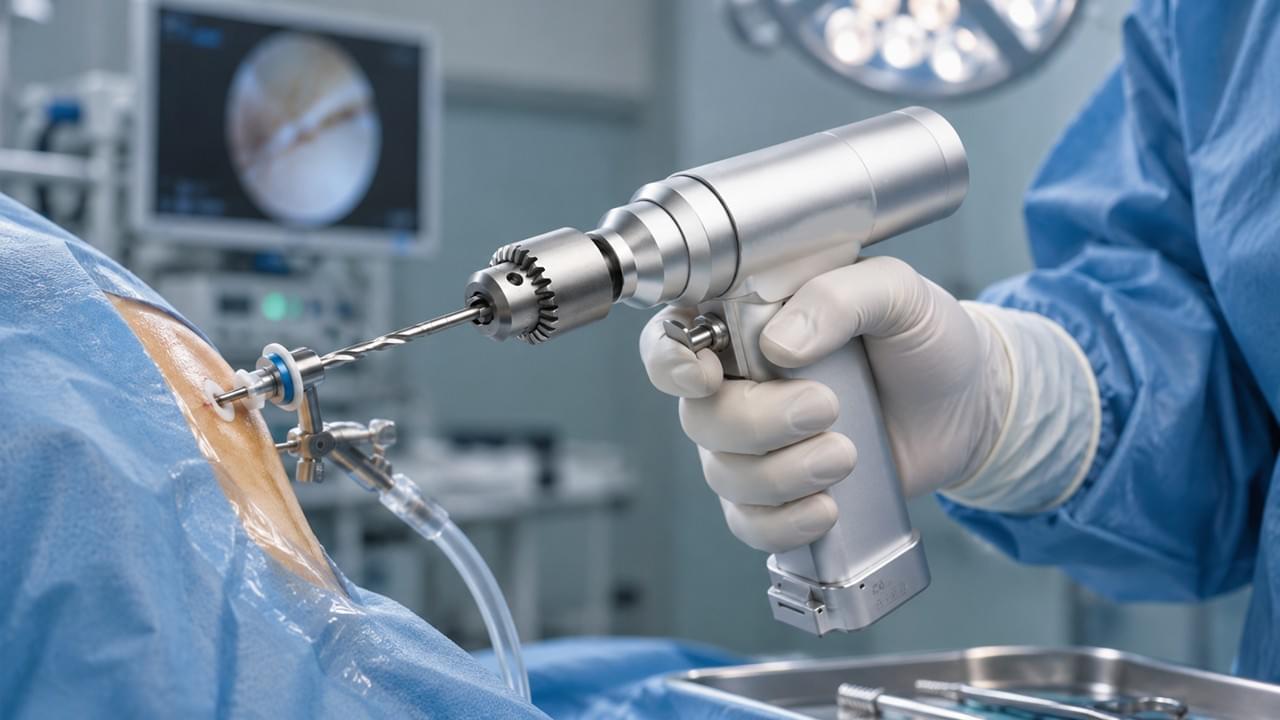
TL;DR: Battery-powered portable power tools have fundamentally expanded what minimally invasive orthopedic surgery can reach. Freed from electrical cords and compressed-air lines, modern cordless drills and saws deliver consistent performance at any surgical position, anatomy, and setting — from major trauma centers to rural field hospitals. This guide covers the technology inside them, the clinical advantages they unlock, and what procurement teams should verify before buying.
Why Portability Changes the MIS Equation 🧭
Traditional orthopedic power tools were tethered — either to wall outlets (AC) or to compressed-air supply lines (pneumatic). Both formats constrain the surgeon’s range of motion, force the OR to be configured around the power source, and create friction that is manageable in open surgery but genuinely restrictive in MIS.
Minimally invasive procedures demand access from unusual angles, positions, and trajectories. A percutaneous fracture fixation of the hip may need the drill held at a steep lateral angle no cable tolerates without tension. A spine case may require rapid angle changes between vertebral levels. Cordless portable power tools remove those constraints entirely: the tool goes where the surgeon needs it.
This article is part of our MIS power tools innovation series. For the full instrumentation picture, see: Minimally Invasive Surgery Power Tools Innovations.
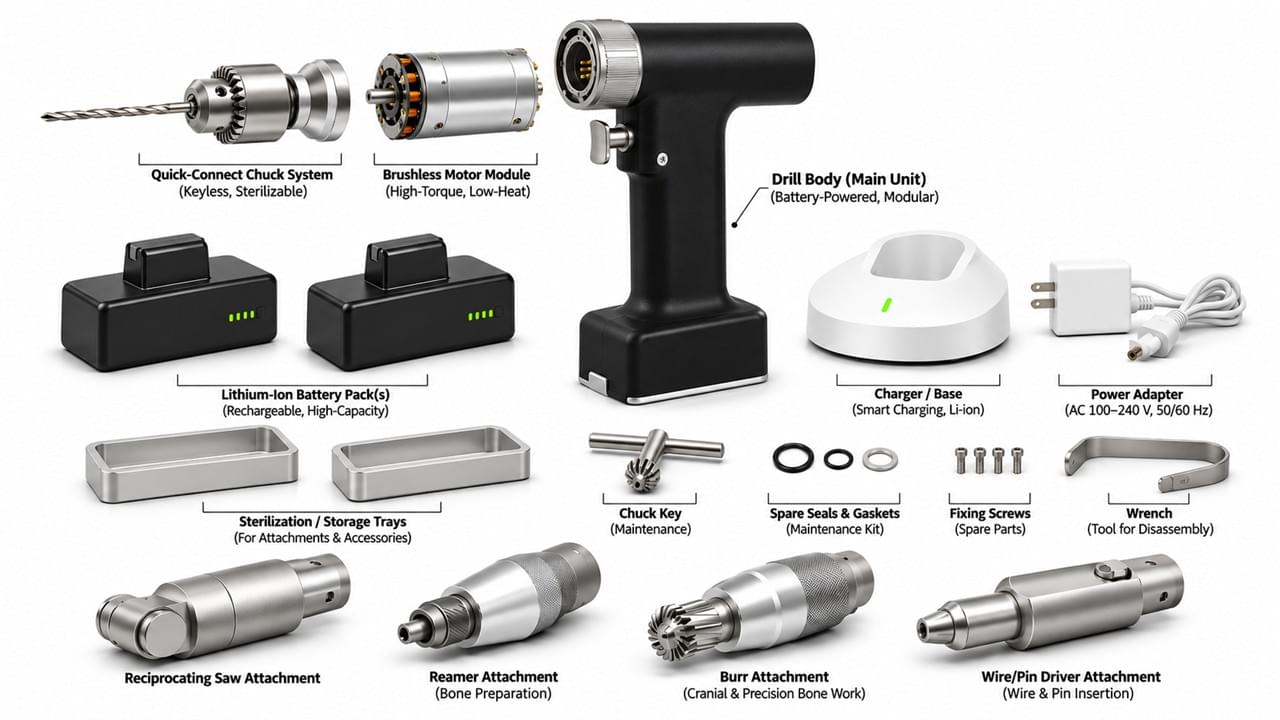
Inside the Tool: The Technology That Makes It Work 🔬
The Battery Systems Behind Portable Power Tools 🔋
The battery defines everything — weight, runtime, sterilization workflow. Surgical batteries have evolved through clear generations:
| Battery Generation | Characteristics | Surgical Application |
|---|---|---|
| NiCd (nickel-cadmium) | Heavy, memory effect, limited cycles | Legacy; largely replaced |
| NiMH (nickel metal hydride) | Better than NiCd, still heavy | Transitional technology |
| Li-ion standard | High energy density, lighter, no memory effect | Current standard |
| Li-ion high-drain | Optimized for surgical power demands | Premium modern tools |
| Li-polymer (LiPo) | Ultra-lightweight, flexible form factor | Emerging ultra-compact designs |
Modern surgical Li-ion packs deliver 45–90 minutes of battery runtime per charge — enough for the vast majority of MIS procedures — across 300–500 validated charge cycles. Two details matter enormously in practice: autoclave compatibility (batteries must survive steam sterilization or slot into a battery-out workflow) and smart charging that prevents overcharge damage and reports remaining capacity.
Brushless Motors: The Precision Core of Portable Power Tools ⚙️
The motor determines torque delivery, speed consistency, and heat inside the handpiece.
Brushed DC motors — the old guard — rely on physical brush-commutator contact: they wear, deliver inconsistent speed under load, and generate heat.
Brushless DC motor technology (BLDC) replaces mechanical commutation with electronics, and the MIS benefits stack up fast:
- Consistent RPM under variable load — speed holds when the bit enters denser bone
- Less heat in the handpiece, which matters in a device held close to the patient
- No brush replacement; longer, more predictable service life
- Quieter operation and a smaller form factor for the same power
Brushless is now standard in premium platforms and rapidly becoming the baseline expectation for MIS-grade instruments.
Ergonomics: Designing for Awkward Angles 🤲
MIS often means operating at arm’s length through narrow channels in anatomically awkward positions. Balance and grip diameter directly shape surgeon fatigue and precision. Some platforms add fixed or variable-angle handpieces that direct the cutting tip around anatomical corners — access a straight tool physically cannot achieve. Low-profile quick-connect chucks keep the total tool-plus-bit assembly short enough for deep, narrow corridors.
From the OR to the Field: Where Portability Pays 🏥
Where Portable Power Tools Make the Difference 🏥
Arthroscopic and joint procedures. In knee, shoulder, and hip arthroscopy, the tool works inside a fluid-filled joint through 5–10mm portals. Cordless wins because there is no cord fighting the arthroscope, compact size aids maneuverability, and battery-steady speed matters for shaver and bur applications.
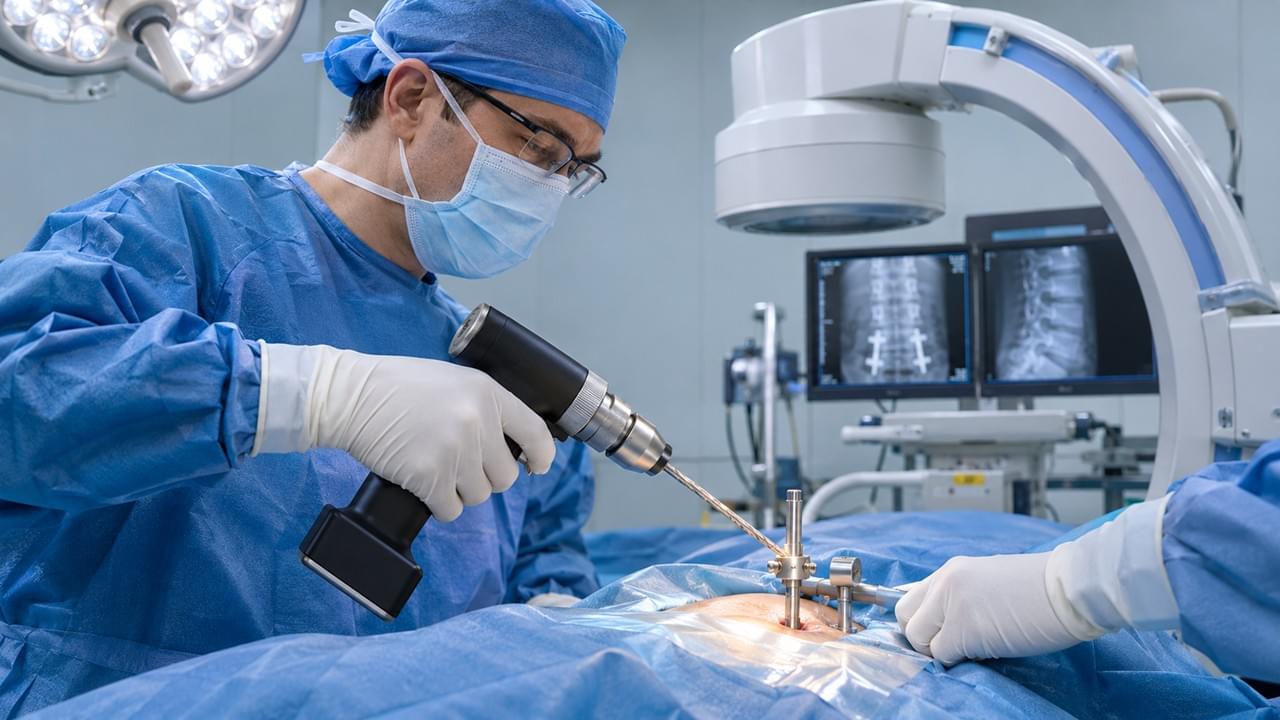
Percutaneous fracture fixation. For hip, pelvis, and long-bone screw fixation, C-arm positioning dominates the room layout — cords add chaos. Patients sit supine, lateral, or prone, and cordless tools adapt to all three. Faster setup also means less operating time and less blood loss.
Field and resource-limited settings. Military forward surgical teams, global mission programs, and emergency suites with unreliable power all depend on equipment that brings its own energy. Sterilizable, pre-charged, transportable battery systems make surgery possible where pneumatic and AC tools simply cannot function.
Portable vs. Corded vs. Pneumatic: The Honest Comparison ⚖️
| Parameter | Battery-Powered Portable | AC-Powered Corded | Pneumatic (Compressed Air) |
|---|---|---|---|
| Range of motion | Unrestricted | Cord-limited | Hose-limited |
| OR setup complexity | Minimal | Moderate | High (air supply) |
| Speed consistency under load | Excellent (brushless) | Excellent | Variable (pressure-dependent) |
| Torque output | High (modern Li-ion) | High | Very high |
| Autoclavable | Yes (battery-out workflow) | Limited | Yes (no battery concern) |
| Noise level | Low | Low | High |
| Field/portable use | Yes | No | No |
| Capital cost | Moderate-High | Low-Moderate | Moderate |
The trade-off is honest: pneumatic still owns extreme high-torque reaming, and corded platforms carry lower capital cost. But for the drill and driver applications that dominate MIS, cordless has closed the gap — and it is the only option that travels. For heat considerations when drilling, see thermal control in MIS; for the bits themselves, small diameter drill bits for MIS.
A word on lifetime cost: the higher upfront price of a battery platform looks different once you model five years of use. Pneumatic systems quietly bill you through compressor maintenance, air-quality monitoring, and the plumbing that keeps sterile air lines compliant. Corded systems rack up replacement costs every time a cable fails inspection. Battery platforms concentrate their cost in replacement packs — so the real procurement question is not “what does the handpiece cost,” but “what does the battery ecosystem cost per surgical year, and how easy is it to get spares in my region?” Ask suppliers that question directly; the good ones answer with numbers.
Before You Buy: The Procurement Checklist 🛒
The Sourcing Checklist for Portable Power Tools ✅
Hospital procurement teams and distributors should verify six things:
- Battery runtime and cycle life — demand testing under surgical-use conditions, not light-load bench numbers
- Sterilization compatibility — confirm autoclave validation (132°C/270°F, 4- or 18-minute cycle as applicable)
- Motor type — specify brushless DC for MIS-grade applications
- RPM range and torque specs — match to your procedural mix (drill, saw, reamer)
- Attachment compatibility — AO quick-connect, Jacobs chuck, or proprietary: confirm fit with existing inventory
- Service and support — battery replacement paths, motor service intervals, and loaner instruments during service
Expert perspective — Vsun Medical Product Development: “We designed our portable MIS power tool series with one principle: the tool should never be the limitation. Battery runtime exceeds the 95th percentile of procedure time for our target applications. The brushless motor delivers the same torque in the 20th minute as the 1st. The only variable the surgeon should be managing is technique.”
Technique standards worth consulting: AAOS instrumentation resources and the AO Foundation’s power tools guidance.
Go Cordless with Confidence 🚀
Vsun Medical portable surgical Orthopedic Power Tools deliver consistent performance wherever surgery happens — no cord, no air supply, no compromise.
- ✅ Brushless DC motor for consistent MIS precision
- ✅ High-drain Li-ion batteries, 45–90 min runtime
- ✅ Full autoclave sterilization compatibility
- ✅ AO quick-connect and standard chuck options
- ✅ 2-year warranty, GMP-manufactured
Request Product Catalog & Pricing →
FAQ
Q1: Can battery-powered surgical drills match the torque of pneumatic tools?
For standard orthopedic MIS applications, yes — modern high-drain Li-ion brushless drills reach torque outputs comparable to many pneumatic tools. Extreme high-torque work such as large-diameter reaming may still favor pneumatics, but for the drill/driver applications that dominate MIS, battery power is fully capable.
Q2: How long does a surgical power tool battery last per charge?
Typically 45–90 minutes of active use — sufficient for most MIS procedures. Verify capacity and discharge rate under surgical load with the manufacturer; many systems ship with two batteries so one charges while the other works.
Q3: Can portable surgical power tools be autoclaved?
Yes, with proper design. Most modern platforms use a battery-out workflow — battery removed, handpiece autoclaved separately — while some designs allow full-assembly autoclavation. Always follow the manufacturer’s validated cycle parameters for temperature, time, and pressure.
Q4: What is the advantage of a brushless motor in a surgical drill?
Consistent RPM under variable load — speed holds even entering denser bone — without the mechanical wear and heat of brushed motors. The result is predictable cutting performance throughout the procedure and longer tool service life.
Q5: Does Vsun Medical offer battery-powered MIS power tool systems?
Yes. The Vsun Medical portable range includes brushless-motor battery-powered drills, saws, and drivers designed for MIS orthopedic and trauma applications. Contact us for specifications and compatibility information.
Published by Vsun Medical | GMP-Certified Capsule & Surgical Equipment Manufacturer
 English
 Arabic
 German
 French
 Italian
 Spanish
 Russian
 Japanese
 Korean
 Turkish
 Portuguese