
📘 This article is part of our comprehensive guide: Veterinary Orthopedic Surgery: Modernizing Animal Surgical Care
TL;DR: Veterinary surgical tools and human instruments share fundamental technology, but they diverge sharply in size range, ergonomics, regulation, and price. This article breaks down the six differences every veterinary procurement officer and distributor should understand before sourcing — plus a practical look at when human instruments genuinely work in animal surgery and when they do not.
🤝 Shared Foundations: What Both Tool Types Have in Common
Before the differences, the common ground. Veterinary and human orthopedic power tools share:
- ⚙️ Drive systems — electric motor or pneumatic turbine, same fundamental power generation
- 🎛️ Speed and torque control — electronic or pneumatic throttle mechanisms
- ♨️ Autoclave compatibility — both must withstand 134°C steam sterilization
- 🧪 Materials — surgical-grade stainless steel or titanium alloy, equivalent standards
- 🔩 Connection systems — the AO/SYNTHES quick-release is widely used in both markets, enabling cross-system attachment compatibility where dimensions match
That shared technology is exactly why so many practices assume one platform can serve both species. The differences below explain why it is rarely that simple. For a broader look at the power tool landscape, see our Orthopedic Power Tools: Complete Guide.
📊 6 Key Differences, Side by Side
1. Size Range: The Defining Feature of Veterinary Surgical Tools
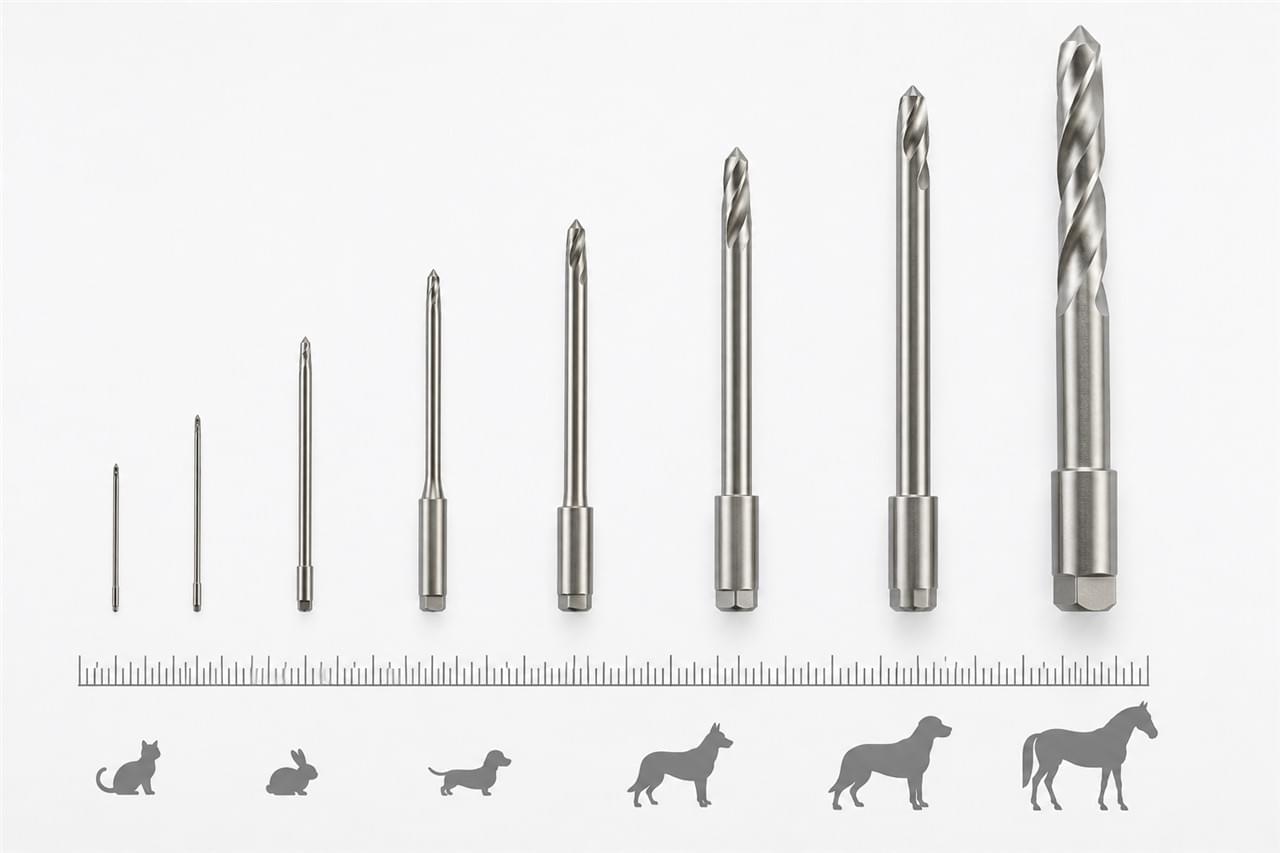
Human orthopedic instruments are optimized for adult human anatomy: standard drill bits from 2.0 to 12.0 mm, reamers at 8.0–22.0 mm, saw blades 15–50 mm wide. Veterinary instruments must cover a vastly wider span — pins from 0.8 mm (feline) to 8.0 mm (large dog/equine), external fixator components from 1.0 mm micro-pins to 6.0 mm, and saw blades from 8 mm mini to 40+ mm.
This is the defining engineering challenge of veterinary instrument design: one product line serving a 2 kg cat and a 600 kg horse must span an 8-fold weight range with appropriate instrument scaling.
2. Handpiece Ergonomics: Built for Different Bodies
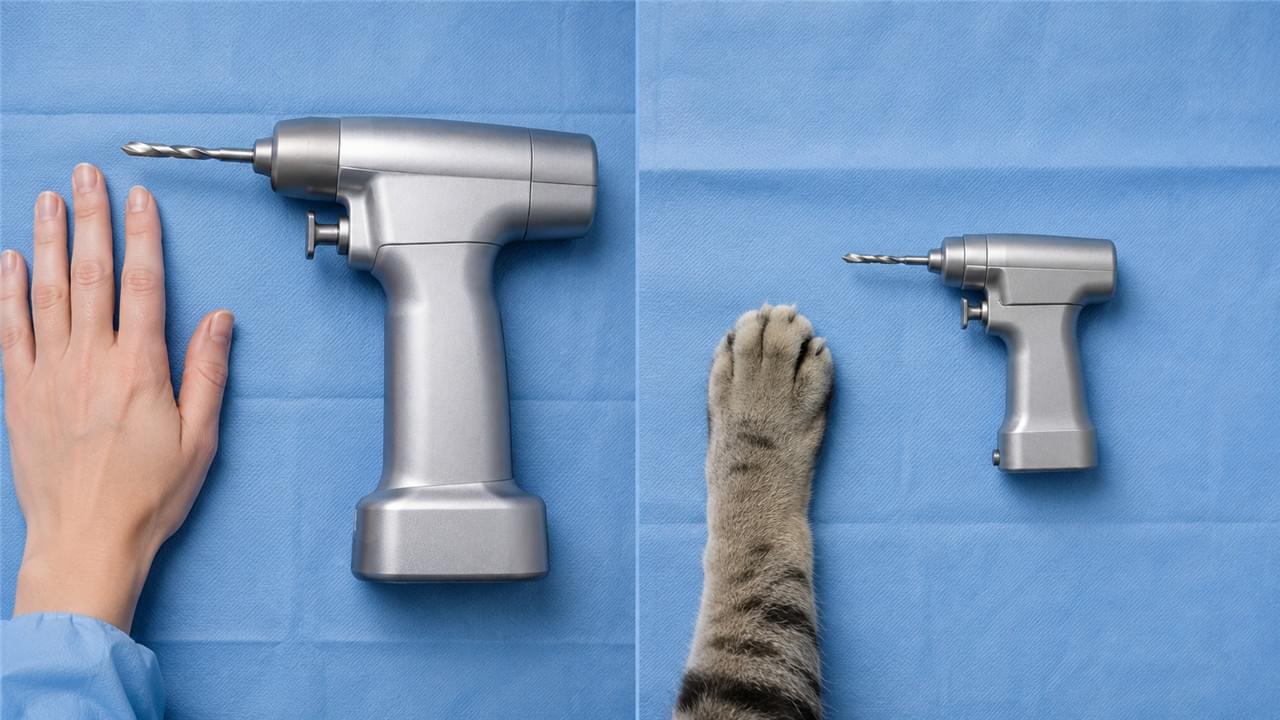
Human handpieces suit surgeons working at OR table height, accessing from above or laterally, with a standard grip diameter of 25–35 mm. Veterinary handpieces address a different reality — animals positioned in dorsal or lateral recumbency on padded tables, confined surgical access in small patients, and the occasional need for angled or pistol-grip configurations. Ergonomics is not cosmetics; it directly affects precision over long procedures.
3. Regulation: Why Veterinary Surgical Tools Get Lighter Oversight
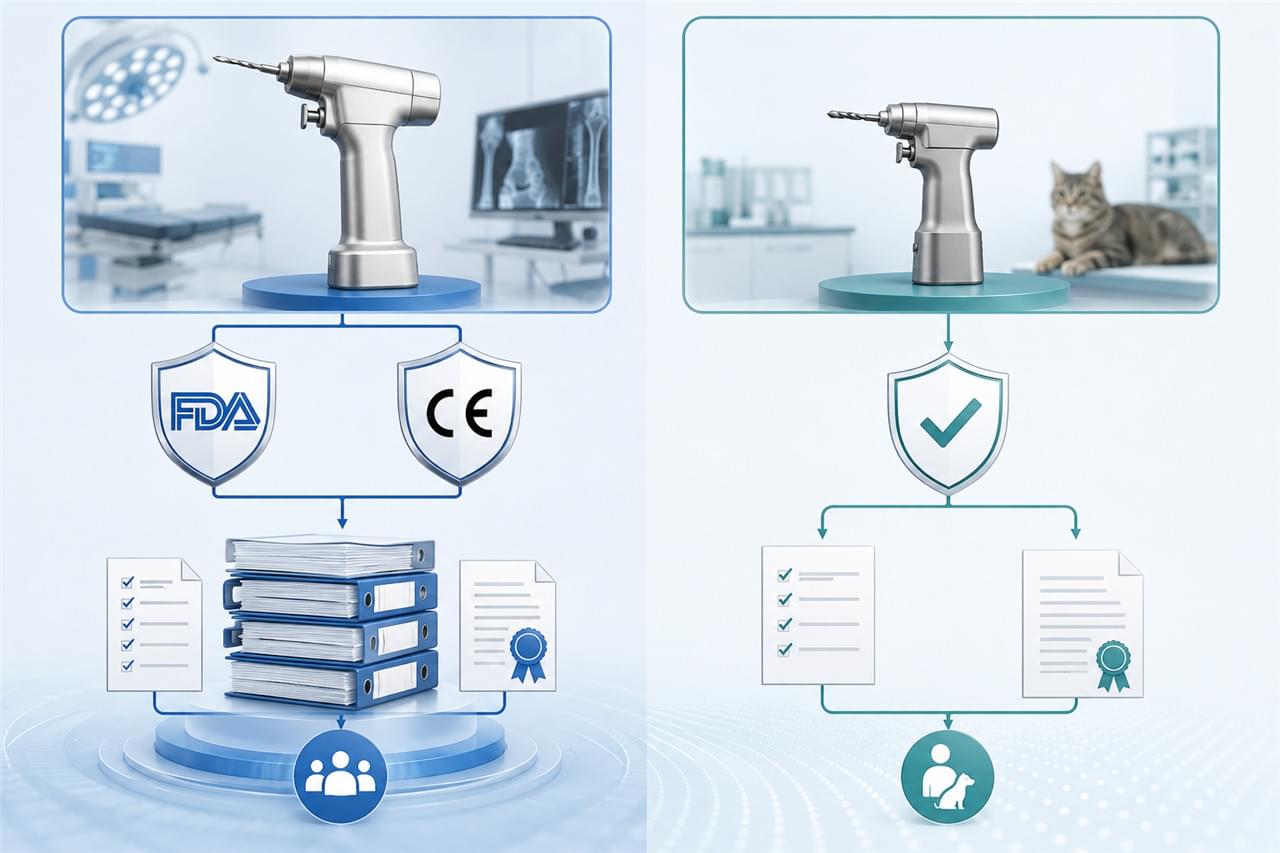
This is the most significant practical difference between the two categories:
| Regulatory Dimension | Human Medical Devices | Veterinary Devices |
|---|---|---|
| US regulation | FDA 21 CFR Part 820; 510(k) or PMA clearance | No FDA mandatory pre-market clearance |
| EU regulation | EU MDR 2017/745; CE marking | No equivalent mandatory EU regulation |
| Quality system | ISO 13485 required for market access | Voluntary; GMP applied by quality-conscious manufacturers |
| Pre-market testing | Biocompatibility (ISO 10993), performance validation, clinical evidence | Manufacturer’s discretion |
| Post-market surveillance | Mandatory vigilance reporting | Voluntary (some national requirements) |
| Import documentation | FDA registration or CE certificate required | Generally not required |
Do veterinary power tools need CE marking? No — CE marking under EU MDR applies to products intended for human use, and veterinary devices fall outside it. What matters in practice: some manufacturers voluntarily hold ISO 13485 certification and apply CE-equivalent standards as a quality signal to sophisticated buyers. Because veterinary instrument regulation is lighter, quality varies widely across suppliers — which is exactly why GMP-compliant manufacturers stand out. For deeper context on quality systems, read our article on Quality Standards in Medical Manufacturing. The FDA medical device regulatory framework and EU MDR 2017/745 are the reference points for the human side of the comparison.
4. Sterilization: Same Standard, Simpler Settings
Both human and veterinary instruments need the same steam autoclave cycle — 134°C, 18 minutes, pre-vacuum — and both must survive repeated cycles without degradation. The difference is practical: veterinary clinics typically run smaller, less sophisticated sterilization setups, often tabletop autoclaves rather than full hospital CSSD. Veterinary instruments therefore have to deliver reliable sterilization results in simpler, less automated systems.
5. Power Systems: Battery Wins in Veterinary Practice
Human surgical settings still lean on pneumatic systems where central air infrastructure exists. Veterinary practice has gone cordless for good reasons: most clinics lack compressed air, portability enables farm visits and mobile units, and there is no hose-and-air-supply logistics to manage. For veterinary surgical power tools, battery-powered platforms are the pragmatic default.
6. Cost: What Veterinary Surgical Tools Really Cost
| Cost Element | Human Medical Device | Veterinary Device |
|---|---|---|
| Regulatory cost embedded | High (FDA/CE compliance) | Lower (no mandatory burden) |
| Typical drill handpiece | $1,500–4,000 USD | $500–1,500 USD |
| Blades/attachments | Higher | Lower |
| Total instrument set | Higher | 20–50% lower |
The 20–50% price gap is not a quality statement — it mostly reflects the regulatory burden removed. The same GMP discipline and materials can produce a veterinary drill at a fraction of a human equivalent’s price.
🔄 When Human Instruments Work in Veterinary Surgery
The Overlap Zone: Implants That Translate
Certain human orthopedic components are used routinely in veterinary surgery: standard AO plates and screws (2.7 mm, 3.5 mm DCP/LCP) in medium and large dog bone plating, K-wires and Steinmann pins universally, 4.0 mm cannulated screws in canine fracture fixation, and modified human intramedullary nails in large animal orthopedics.
Is it legal? In most countries, yes — there is no legal prohibition on using human-approved devices in veterinary patients (the reverse would require human approval). Professional judgment governs appropriateness for each patient and procedure.
The Size Wall: Why Micro Cases Need Veterinary Surgical Tools
The limiting factor is size. Attachments scaled for human adult anatomy are too large for small animal bones under 5 mm diameter — and a human AO drill on a cat fracture is a recipe for frustration even when the chuck can accept micro bits. The large handpiece and higher torque make precise micro-drilling technically challenging. For consistent results in small animal surgery, a compact veterinary handpiece with an appropriate speed range is the right call.
🧠 Expert Advisory: A Hybrid Procurement Strategy
Vsun Medical Product Application Team:
“For a mixed practice serving small animals through large animals, we recommend a tiered approach: purchase a veterinary-specific power tool platform with the widest attachment range — micro to large — which eliminates the headache of managing multiple incompatible battery platforms. Supplement it with human-standard implant hardware (plates, screws, K-wires) for the sizes that overlap with human ranges. This hybrid approach delivers the broadest capability at the most efficient inventory investment.”
Pair that with a proper instrument set plan: our guide on How to Configure a Veterinary Orthopedic Instrument Set walks through the tiered build-up in detail.
✅ Source Medical-Grade Veterinary Instruments
Vsun Medical manufactures veterinary surgical equipment under the same GMP manufacturing standards and ISO quality management as our human medical device product lines — with a 2-year warranty and global supply capability.
What certifications should you require from a supplier? In the absence of mandatory veterinary regulation, ask for: ISO 13485 certification (voluntarily held by quality-conscious manufacturers), GMP compliance documentation, material certification for surgical-grade stainless steel, sterilization cycle validation data, and a minimum 2-year product warranty. These voluntary indicators meaningfully separate high-quality suppliers from the rest. Our veterinary surgical equipment range carries all of them.
📋 Request Veterinary Product Catalog → vsunmedical.com/contact
Or explore the full veterinary surgical equipment product range.
GMP Compliant · ISO Certified · 2-Year Warranty · Human-Grade Quality for Veterinary Use
 English
 Arabic
 German
 French
 Italian
 Spanish
 Russian
 Japanese
 Korean
 Turkish
 Portuguese